Moving your infrastructure to the cloud doesn't eliminate security risks - it changes them.

You're no longer worrying about physical server access or backup tapes, but you are dealing with things like misconfigured storage buckets, overprivileged service accounts, and the possibility that someone in accounts might click the wrong link and hand over confidential information to your entire infrastructure.
The problem most organizations face isn't a lack of awareness about cloud security risks. It's that
proper security measures cost money, and budgets are limited. You can't protect everything equally, and trying to do so usually means you protect nothing particularly well. The question becomes: how do you decide where to spend your "security dollars" in a way that actually reduces risk rather than just making you feel better?
Understanding the Dual Challenge
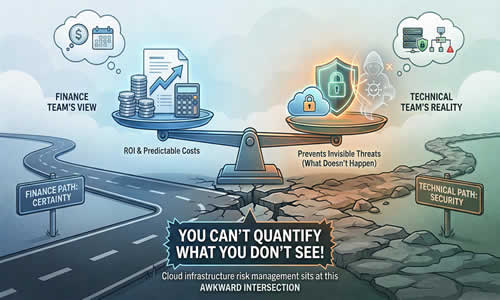
Cloud infrastructure risk management sits at an awkward intersection. Your finance team wants predictable costs and clear ROI. Your technical team knows that security spending often prevents things that never visibly happen.
When a breach doesn't occur, no one notices, which makes justifying next year's security budget difficult.
You can’t quantify what you don’t see!
This creates a pattern where organizations underspend on prevention and overspend on response. A company might balk at a $15,000 annual contract for proper identity and access management but then be forced to spend $200,000 recovering from a ransomware incident that better access controls would have prevented.
The cloud adds complexity because
costs can spiral quickly. You're paying for computing, storage, data transfer, and now you need to add security services on top. Each extra security tool adds to your monthly bill … and many security providers price their products based on usage metrics – which obviously grow as your infrastructure grows.
Prioritizing Risks to Maximize Security ROI
Not all risks deserve equal attention or budget. A misconfigured database containing customer payment information represents a materially different threat than a development server running outdated libraries. Yet organizations often spread their security budget evenly, applying the same controls everywhere regardless of actual risk.
Start by identifying what you're actually protecting. What data, if exposed, would cause regulatory penalties, customer loss, or operational disruption? Where are your authentication boundaries, and which ones matter most? A payment processing system deserves different investment than an internal wiki.
A good example would be in using a resource like the
IT security team at GitsTel who play a pivotal role in helping companies to deal with this complex landscape. By providing specialized cybersecurity services, they help to conduct comprehensive risk assessments tailored to specific cloud environments.
Consider a mid-sized retail company with both an e-commerce platform and internal HR systems. They might spend 60% of their security budget protecting customer data and payment flows, 25% on employee access management, and 15% on everything else. This isn't about ignoring lower-priority systems - it's about being honest that a breach of customer credit card data costs more than someone accessing last year's holiday party photos.

Risk prioritization also means accepting that some vulnerabilities will remain unpatched because the cost of fixing them exceeds their potential impact. This sounds irresponsible until you realize that perfect security doesn't exist and every dollar spent on low-impact fixes is a dollar not available for high-impact protection.
Using IT Consultancy for Strategic Cloud Risk Management
Most organizations lack the internal expertise to properly assess cloud security risks, especially how they relate to budget allocation. Your infrastructure team knows how to deploy applications, but they may not understand the relative threat levels of different attack vectors or how to calculate the actual cost of different security measures.
This is where external expertise becomes valuable - not for ongoing management, but for strategic assessment. A good IT security consultant can audit your current setup, identify where you're over-invested in low-impact areas (and under-invested in critical ones), and create a roadmap that aligns spending with actual risk. Companies like
iMedia Technology, an IT consultancy, provide this kind of guidance by balancing organizational risk appetite and budget constraints.
The key is using consultancy for strategy rather than execution. Bringing in experts for a quarterly review costs far less than maintaining a full-time security team, but it still gives you access to specialized knowledge about emerging threats, regulatory requirements, and which security investments typically provide the best return.
Consultants also provide political cover. When an external expert tells your board that you need to reallocate budget from one area to another, it carries more weight than the same recommendation from internal staff who might be seen as protecting their own departments.

Implementing a Layered Security Framework
Security professionals talk about "defense in depth," which sounds impressive but essentially means: don't rely on any single security control to protect you. If someone gets past your firewall, you want identity management to stop them. If they compromise a user account, you want data encryption to protect sensitive information.
Within budget constraints, this means identifying which layers provide the most value and implementing those first. For cloud infrastructure, this usually starts with identity and access management - ensuring that users and services only have the permissions they actually need. This costs relatively little but actually prevents a whole host of attacks.
Next comes network segmentation. Dividing your cloud environment into separate zones means that even if attackers compromise one area, they can't automatically access everything else. This doesn't require expensive tools—most cloud providers offer basic network controls at no additional cost beyond the time needed to configure them properly.

Data encryption often gets treated as optional or something to add later, but
it should be fundamental. Encrypting data at rest and in transit costs almost nothing in modern cloud environments but dramatically reduces the impact of lots of breach situations.
The mistake people often make is trying to implement every possible security layer simultaneously, running out of budget halfway through, and ending up with partial implementations that don't actually protect anything. Let’s face it, it’s better to fully implement three critical layers than half-implement ten…
Continuous Monitoring and Incident Response
Here's an uncomfortable truth: you're going to have security incidents. Someone will misconfigure something, a credential will get compromised, or a zero-day vulnerability will affect a service you depend on. The question is whether you detect and respond to these incidents quickly, or whether they sit unnoticed until they become catastrophic.
Continuous monitoring doesn't mean watching dashboards 24/7. It means setting up automated alerts for specific indicators that something has gone wrong. This means unusual access patterns, configuration changes in production environments, and failed authentication attempts from unexpected locations. Cloud providers offer basic monitoring as part of their platforms; you just need to configure it properly.
Incident response planning costs almost nothing but time. Document who needs to be notified when different types of incidents occur, what steps to take immediately, and who has authority to make decisions about shutting down systems or isolating compromised resources. This preparation dramatically reduces the cost and impact of breaches when they happen.
The cost-saving aspect comes from catching problems early. A compromised service account detected within hours might cost you a few thousand dollars in investigation and remediation. The same compromise undetected for three months could mean stolen data, regulatory fines, and customer notification costs running into six figures. Maybe a whole tsunami of legal challenges…

Training and Awareness
Contrary to popular opinion, most cloud security incidents don't result from sophisticated attacks. They result from people simply making mistakes or not understanding the consequences of their actions. A developer who doesn't realize that making an S3 bucket public exposes all its contents to the internet. Or an administrator who sets overly broad permissions because it's easier than figuring out the minimum required access.
Security training often gets treated as a compliance checkbox: everyone watches a video once a year, clicks through a quiz, and nothing changes. Effective security awareness is
ongoing and specific. When someone makes a configuration error that creates risk, that's a training opportunity. When you implement a new security control, the people affected need to understand not just what to do differently, but why it matters.
And for cloud infrastructure, anyone with the ability to create or modify resources needs to understand the security implications of their actions. This doesn't require making everyone a security expert, but is does mean making sure they know enough to avoid common mistakes … and recognize when they should ask for help.
The return on investment for security training is hard to measure, which makes it easy to cut from budgets. But consider: if training prevents even one significant incident per year, it has paid for itself many times over!

If you'd like to learn more about what we provide, why not take a look at how we can help?
Boost your skills with our market-leading online courses at super-low prices.
Strategic Alignment for Sustainable Cloud Security
Balancing cloud security and budget comes down to making conscious decisions about where to accept risk and where to invest in mitigation. This requires ongoing assessment as your infrastructure evolves, threats change, and your business priorities shift.
The organizations that do this well treat security as an integral part of infrastructure planning rather than something bolted on afterwards. They make risk-based decisions about security spending, accept that perfect security doesn't exist, and focus their limited resources on protecting what actually matters.
This isn't about finding clever tricks to get enterprise security on a startup budget. It's about being strategic: understanding your risks, prioritizing ruthlessly, and investing in controls that provide genuine protection rather than just checking compliance boxes.
You will never eliminate risk, but by following what we’ve said here to achieve a balance of protection and cost control, you’ll be in the best position you can.