By four in the afternoon, something has drained out of the room. People are still at their desks. The work is still moving. But the quality of attention has visibly dropped, and everybody feels it without quite naming it.
Managers usually blame the meeting load, or the season, or a general dip in motivation.
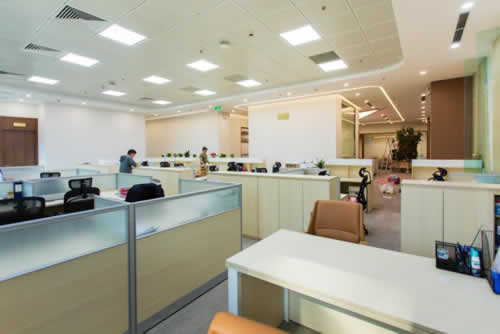 In this ZandaX article, we show how the more likely explanation is that your team has spent seven hours doing two jobs at once. Their actual work, and the continuous background task of filtering out everyone else's conversations.
The Misdiagnosis: Blaming the Layout
Open plan design was sold on collaboration. Remove the walls, the reasoning went, and people will talk more.
The evidence went the other way. A Harvard study tracking employees at two Fortune 500 companies before and after a move to open plan found that face-to-face interaction dropped sharply rather than increasing, while
electronic messaging rose. People did not collaborate more: they retreated into their screens!
That result is often quoted as proof that open plan itself is a failure, and this is where the diagnosis usually goes wrong. The layout is not really the variable. Sound is.
A number of surveys have found that around 70% of workers in both shared and open-plan offices reported difficulty concentrating as the main effect of irrelevant speech noise. The same paper notes earlier research finding that occupant complaints about noise increased roughly tenfold in open-plan offices compared with cellular ones, alongside reported increases in fatigue, headaches and sickness absence.
Tenfold. Not because the walls came down, but because the sound they used to absorb came down with them.
Why Sound Absorbing Panels Are a Business Decision, Not a Décor One
Here is the part most offices skip, and it’s the
cheapest intervention available.
Hard surfaces are the actual problem. Glass, plasterboard, exposed concrete and polished floors all reflect sound rather than absorbing it. Take out the partitions, the carpet and the soft furnishings, and you have built a room that amplifies every conversation in it.

The fix is to put absorption back into the room. Wall-mounted
acoustic panels from suppliers like Felt Right work as sound absorbing panels rather than reflectors, soaking up sound energy instead of bouncing it, which lowers the reverberation that makes a room feel loud even at moderate volume.
This gets dismissed as an aesthetic upgrade because the panels are visible and often decorative. That framing costs companies real money. You are not buying wall art. You are buying back the concentration your floorplan removed.
It is also worth noting the direction of travel here. Many organizations are already quietly retreating from fully open layouts, adding zones, pods and enclosed focus rooms. Acoustic treatment is the version of that retreat that does not require rebuilding anything.
The Specific Culprit Is Speech You Can Understand
Not all noise is equal, and this is the detail that changes what you should actually fix. Research into the irrelevant speech effect found that in one survey, 58% of employees named noise as the greatest source of annoyance in open plan offices, and that intelligible speech disrupted everyday tasks
more than any other sound.
Intelligible is the operative word. Traffic hum, air handling, a printer, even unintelligible chatter from far enough away are all far less disruptive than a conversation you can make out.
The reason is mechanical rather than emotional, which is why willpower does not help. Your working memory processes language automatically. When you can understand words, your brain parses them whether you want it to or not, and that parsing competes directly with whatever you were trying to think about at the time.
This is why headphones-and-music is only a partial fix, and why lyrics-free music works better for many people than their actual favorite album.
Which Work Suffers, and Which Doesn’t
The disruption is not spread evenly across a team, and knowing the pattern lets you place people sensibly. A study testing different cognitive tasks under quiet and irrelevant-speech conditions found that work relying on short-term memory and mental rehearsal of material was significantly more vulnerable to disruption than work drawing on long-term memory retrieval.

In practical terms, this means the following work degrades fastest in a noisy room:
Reading anything you need to retain.
Writing, particularly first drafts.
Detailed checking,
reconciliation, and anything involving
sequences of numbers.
Learning a new system or process.
And this work holds up comparatively well:
routine tasks you already know,
calls and conversations,
physical or hands-on tasks, and anything creative that benefits from
ambient stimulation.
If your finance team and your sales floor share a room, one of them (guess which one...) is being quietly penalized every minute of every day.
What Actually Helps
Absorption first. Soft surfaces on walls and ceilings do more for a room than any amount of desk rearranging, because they treat the cause rather than the symptom.
Zone by task, not by department. Group the concentration-heavy work together and away from the conversational work. Most offices do the opposite, seating people by team. Give people somewhere to go. A single properly quiet room for deep work is worth more than a dozen breakout sofas, and it will be booked solid, which tells you something.
Be careful with white noise, too. Sound masking can help by making speech less intelligible, but if it's poorly implemented, it simply adds another layer of sound to a room that already has too much.

If you'd like to learn more about what we provide, why not take a look at how we can help?
Boost your skills with our market-leading online courses at super-low prices.
The Point Worth Taking Away
Nobody on your team is going to file a complaint saying the reverberation time in the office is too high. They will just be tired, slightly shorter with each other, and less productive in the afternoon than they were at ten in the morning.
Open plan is not inherently broken. But an untreated open plan room usually is! The difference between the two is mostly a question of what your walls are doing with sound, and that is one of the few workplace problems you can genuinely fix in an afternoon.