If you run a regulated business, you've probably noticed a quiet shift over the last few years: the cloud stopped being an experiment and became the default. Yes, that's great for agility and scale, but it has also made compliance more fragile, more complex, and more exposed than most of its devotees are comfortable admitting. AI is now being sold as the answer to all of this, but in reality, it's neither a silver bullet nor a fad. Used well, it can shore up weak points in cloud governance and help teams keep up with the pace of change. Used badly, it just adds another layer of
risk and noise.

Understanding Compliance Challenges in Cloud Infrastructure
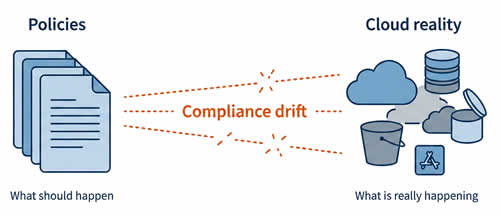
Compliance in the cloud is harder than in the old data center world for one simple reason: you no longer control everything end to end. You are building on top of services you don’t own, in environments that can change overnight, across regions you may not even realize you are using. That flexibility is powerful, but it makes it much easier for the real world to drift away from what your policies say should be happening.
For regulated industries, that drift is not theoretical. An engineer can spin up a new storage bucket or database in minutes, but data residency rules, retention requirements, and access controls don’t magically configure themselves. The more teams you have, the more cloud accounts, and the more regions, the harder it becomes to answer basic questions: Where is sensitive data stored? Who can access it? Which systems touch regulated information, even indirectly?
On top of that, regulation itself isn't static. You might be dealing with overlapping requirements from financial regulators, privacy laws, sector-specific frameworks, and internal risk policies that are stricter than any external rule. When your cloud footprint changes every week and your regulatory environment evolves every year, manual reviews and spreadsheet-driven audits simply cannot keep up. That is the gap where AI is now being pushed as a helper—or, depending on the vendor pitch, a savior.
One effective approach involves using the expertise of specialized professionals to tackle these problems. Engaging companies like
FTI Services' IT consultants can clarify understanding of the connection between cloud technologies and regulatory compliance. This will produce tailored solutions that avoid costly mistakes, and are both effective and scalable.
The Role of AI Innovations in Enhancing Compliance
Most AI in this space is not about futuristic general intelligence; it is about pattern recognition at scale. Cloud environments generate enormous volumes of configuration data, access logs, network flows, and change history. Humans are quite good at interpreting context and intent, but quite bad at watching a firehose of signals 24/7. AI, especially in the form of machine learning models, can sift through that volume and highlight what looks unusual, misaligned, or outright dangerous.
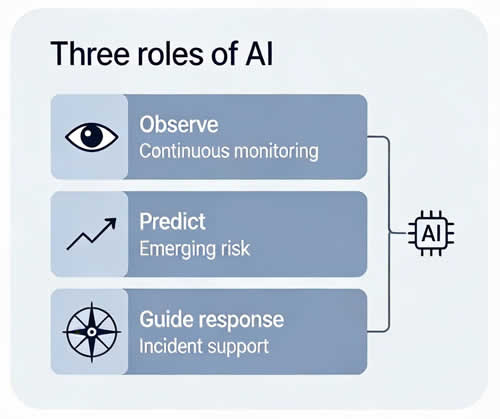
At a high level, AI can play three roles for cloud compliance in regulated industries. First, it can act as a constant
observer, scanning configurations and activity for policy violations and risky patterns that would be tedious for people to find by hand. Second, it can help
predict where issues are likely to emerge, rather than only reacting once an auditor or incident forces the issue. Third, it can
guide or even orchestrate responses when something goes wrong, helping teams move faster without slipping outside regulatory boundaries. The value is not in replacing compliance officers or cloud architects, but in giving them better visibility and better timing.
There's a catch, though. If the models are trained on poor-quality data, if their rules are opaque, or if they are wired too aggressively into automation, they can create a new kind of blind spot. You end up with “compliance theater” rooted in AI: lots of dashboards and alerts, but no real improvement in how closely your cloud operations match your obligations. That is why a skeptical, testing mindset is healthy when you bring AI into regulated environments.
Combining the advantages of AI with expert IT support improves matters further. Companies that utilize solutions like
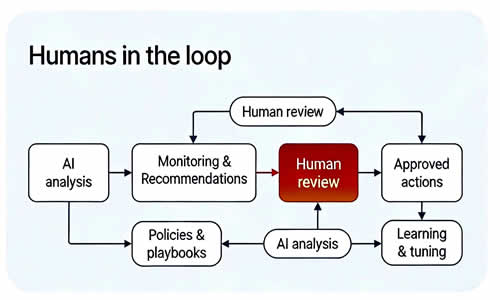
Gamma Tech's computer support benefit from automated monitoring with human oversight as part of the service. Human involvement will validate AI-generated alerts, prioritize risks and oversee responses.
Key AI Innovations Driving Compliance Success
The most useful
AI capabilities for cloud compliance today tend to cluster around three areas: automated policy enforcement, predictive risk analytics, and intelligent incident response. None of these ideas are brand new, but AI makes them more scalable and, when done well, more precise.
Automated policy enforcement
This is about turning your policies into living, executable rules. Instead of having a PDF that says “all storage containing regulated data must be encrypted at rest, with access restricted to specific roles,” you define that rule in code and let systems check and enforce it continuously. An AI layer can help by interpreting large sets of cloud configurations, mapping them back to policy intent, and suggesting or applying corrections when something drifts out of line.
Think of a scenario where a financial services firm uses AI-driven tools to scan every new cloud resource as it is created and automatically flag or fix any configuration that would break internal standards. The humans still set the rules; the AI just watches more closely and reacts more quickly.
Predictive risk analytics
This goes a step further. Instead of only saying, “this configuration violates policy,” it tries to answer, “where are we likely to see trouble next?” Models look at patterns of change, access behavior, and past incidents to infer which systems, teams, or environments are drifting toward higher risk.
Picture a healthcare provider that handles sensitive patient data across multiple regions. Predictive models might detect that one particular environment is seeing frequent permission changes, unusual access times, and a steady increase in exceptions to standard policies. Even if nothing has broken yet, that pattern can prompt a review before an actual breach or regulatory finding occurs.

Intelligent incident response
This is about what happens on the worst day, when something has already gone wrong. In regulated industries, speed and accuracy matter, but so does showing that your response followed a defined process. AI can help correlate signals, propose likely root causes, and recommend response actions that align with your rules.
For example, if suspicious data access is detected in a cloud account tied to regulated workloads, an AI-assisted system might automatically gather the required information, and draft an initial incident summary for the response team. You still need humans to make judgment calls, communicate with regulators, and decide on long-term fixes—but the early minutes and hours become less chaotic.
Implementing AI-Driven Compliance Strategies
The temptation is to start with the shiniest tool and work backwards. A more sensible approach is to begin with a few pointed questions: What are the most painful compliance gaps in your current cloud environment? Where do audits keep turning up the same issues? Where are you relying on manual checks or tribal knowledge to stay on the right side of the rules? If you cannot answer those questions, AI will only give you a more elaborate way to stay confused.
From there, the implementation path tends to look more pragmatic than visionary. Many organizations start by formalizing their policies as code, integrating that with their cloud deployment pipelines, and then layering AI-driven analysis on top to identify patterns and exceptions. That may not sound glamorous, but it turns compliance from something you “do once a year for the auditors” into something that runs quietly in the background every day. Along the way, you will have to tackle data quality: if your asset inventory is out of date, or your tagging is inconsistent, even the best model will struggle to produce useful insights.
The human side matters just as much. Compliance officers and security teams need to understand what the AI is doing, what it is not doing, and how to challenge or override its recommendations. Engineers need to trust that automated enforcement will not randomly break their work in production. A balanced stance is healthy here. Treat AI as a highly capable assistant that can watch everything at once and surface non-obvious risks, but insist on transparency, testing, and guardrails. In regulated industries, you have to assume you will someday need to explain not just what you did, but why you trusted a given system to help you do it.
Conclusion / Wrap up
AI is becoming a serious part of the cloud compliance toolkit, especially for organizations that live under strict regulatory oversight. It shines in the areas where humans struggle: monitoring vast, fast-changing environments, spotting weak signals of emerging risk, and coordinating responses under pressure. Automated policy enforcement, predictive risk analytics, and intelligent incident response are already delivering value when aligned with clear policies and a solid understanding of the business.
But there is a line between using AI to make your compliance practice sharper and outsourcing your judgment to opaque systems. The most resilient regulated organizations will be the ones that use AI to
extend the reach of their people, not to replace them. If you can describe your obligations clearly, translate them into code and controls, and then let AI help you keep everything aligned over time, you have a realistic path to stronger cloud compliance without pretending that technology alone can carry the regulatory burden.

If you'd like to learn more about what we provide, why not take a look at how we can help?
Boost your skills with our market-leading online courses at super-low prices.