Most businesses moved to the cloud because someone said it would be so much simpler. No more server rooms. No hardware refreshes. Just pay monthly and let Amazon or Microsoft handle the infrastructure. What nobody mentioned clearly enough: you're now responsible for security decisions that used to be someone else's problem—and you're making those decisions in an environment where attackers have already figured out every common mistake.

Cloud infrastructure runs modern business. Customer data, financial systems, operational tools—they all live in data centers you'll never visit, managed through dashboards most executives never see. This setup works brilliantly until it doesn't. A misconfigured database exposes everything. A compromised admin account hands attackers the keys. These incidents happen daily, and the businesses affected thought they were protected. Understanding cloud security risks starts with accepting that default settings and assumptions will eventually hurt you.
Understanding the Rising Threats to Cloud Infrastructure
The threat environment has shifted dramatically. Ten years ago, most attacks targeted on-premises servers behind firewalls. Security teams knew their perimeter. But cloud computing changed that equation entirely. Your infrastructure is now spread across multiple data centers, often in different countries, with access points from remote workers, partners, and integrated services.
Attackers exploit this complexity. They know that rushed cloud migrations often skip proper security reviews. They understand that businesses (stupidly?) prioritize speed over configuration checks. A misconfigured storage bucket can expose millions of records. A forgotten admin account becomes an entry point. These aren't theoretical risks - they happen daily.
Consider
this IBM report which said that the global average cost of a data breach had reached an all-time high of 4.45 million USD in 2023, which was a 15% increase over the previous three years.
The Complexity of Cloud Risk Exposure
Cloud environments operate differently from traditional IT infrastructure. You don't own the hardware. You share resources with other customers. Your data might physically reside in three countries simultaneously for redundancy. This architecture creates security challenges that conventional approaches can't address.
Visibility becomes your first problem. In a physical data center, you knew every server, every cable, every access point. In the cloud, services spin up automatically. Developers create test environments that never get shut down. Shadow IT spreads as departments buy their own cloud subscriptions. You can't protect what you can't see.
Responsibility splits between you and your provider. The cloud company secures the infrastructure layer—physical servers, network hardware, hypervisors. You handle everything above that: operating systems, applications, data, user access. This shared responsibility model confuses many businesses. They assume their provider handles all security, then discover too late that critical gaps existed on their side of the fence.

Using External IT Consultancy for Cloud Security
Most businesses lack their own specialized cloud security expertise. Your IT team might be great at managing on-premises systems but struggle with cloud-based architectures. This gap creates risk.
Using specialized IT consultancies can greatly reduce this risk by ensuring that cloud security frameworks align with the latest threat intelligence and compliance needs. An example would be
Integritek, an IT consultancy, which offers tailored advisory services that help businesses deal with complex cloud environments, from design of the architecture to ongoing monitoring and response.
A good consultant starts with a security assessment. They map your cloud footprint, identify misconfigurations, review access controls, and test for vulnerabilities. They don't just hand you a report—they prioritize fixes based on actual risk to your business. Some issues need immediate attention. Others can wait for your next maintenance window.
The value goes beyond finding problems. Experienced consultants help you build security into your cloud operations from the start. They establish governance frameworks, create secure configuration templates, and train your team on cloud-specific risks. This proactive approach prevents issues rather than just responding to them after breaches occur.
Key Risk Areas in Cloud Infrastructure
Misconfiguration and human error
The biggest cloud security failures stem from simple mistakes. An engineer forgets to enable encryption. A developer sets permissions to "public" during testing and never changes them back. An administrator copies security group settings incorrectly. These errors don't require sophisticated attacks - they leave doors wide open.
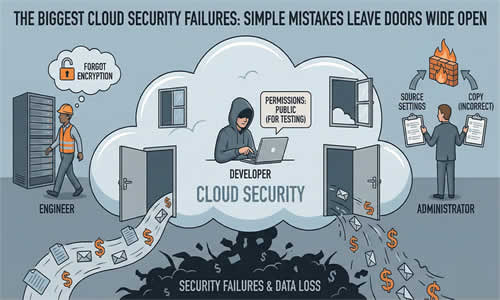
Misconfigurations happen because cloud platforms offer literally thousands of settings. Documentation runs hundreds of pages. Default configurations prioritize ease of use over security. Just one wrong checkbox in your S3 bucket settings can expose your entire data repository to the internet! Automated scanning tools exist, but someone needs to run them regularly and act on findings.
Insider threats and access management
Your employees and contractors need access to cloud systems. Former employees shouldn't, but often retain it. A salesperson leaves your company and joins a competitor … do they still have access to your customer database in the cloud? Many businesses discover the answer is yes, often months after departure.
Access management requires constant attention. Who has administrator rights? Who can view financial data? Who can spin up new cloud resources? Identity and access management becomes more critical in cloud environments because the attack surface expands dramatically. An on-premises breach might affect one location. A cloud account compromise can expose everything, everywhere.
Supply chain and third-party risks
Your cloud security depends partly on providers you've never evaluated. That marketing automation tool connects to your cloud storage. Your payment processor integrates with your database. Each integration creates a potential entry point. When a popular file transfer service suffered a breach in 2023, thousands of their customers discovered their data was exposed - not through their own security failures, but through a vendor's.
Third-party risk extends to your cloud provider's own supply chain. When a major monitoring tool used by cloud platforms was compromised, attackers gained access to numerous enterprise environments. You can't control every vendor's security, but you can limit what they can access and monitor their connections.
How to Reduce Cloud Risk
Use zero trust security models
Zero trust assumes no user or system is inherently trustworthy, even inside your network. Every access request requires verification. Users authenticate not just once at login, but continuously as they access different resources. This approach suits cloud environments where traditional network perimeters don't exist.

Implementing zero trust means verifying identity, checking device health, and limiting access to only what each user needs for their specific role. It requires more upfront configuration but dramatically reduces breach impact. If an attacker compromises one account, they can't automatically pivot to other systems.
Implement continuous monitoring
Cloud environments change constantly. New resources appear, configurations shift, access patterns evolve. Monthly security reviews can't keep pace. Continuous monitoring watches for anomalies in real time—unusual login locations, unexpected data transfers, configuration changes outside maintenance windows.
Effective monitoring requires the right tools and someone to respond to alerts. Many businesses install monitoring systems but lack the capacity to investigate findings. Alerts pile up, creating noise that obscures real threats. Either dedicate internal resources to monitoring or partner with a security operations center that can respond around the clock.
Prioritize data encryption and backup
Encrypt data in transit and at rest. This basic practice protects information even if other security controls fail. If an attacker accesses encrypted data without the keys, they get nothing usable. Cloud providers offer encryption services, but you must enable them and manage the keys properly.
Backup your cloud data regularly, maybe even storing copies in separate locations. Ransomware increasingly targets cloud environments. Attackers encrypt your production systems and your backups if they're in the same environment. Isolated backups let you recover without paying ransoms. Test your backup restoration process—many businesses discover during a crisis that their backups don't work as expected.
Preparing for Future Cyber Threats in the Cloud Era
Cyber threats will continue evolving. AI-powered attacks will probe systems faster and more intelligently. Quantum computing may eventually break current encryption methods. New vulnerabilities will emerge in cloud platforms and services. Your security approach needs to adapt continuously.

Stay informed about emerging threats specific to your industry and cloud platforms. Join security communities, attend relevant conferences, follow threat intelligence feeds. Build relationships with security researchers who understand cloud environments. The knowledge you gain today might prevent a breach tomorrow.
Invest in security training for everyone who touches cloud systems. Developers need secure coding practices. Administrators need configuration best practices. Business users need to recognize phishing attempts that target cloud credentials. Security isn't just the IT department's job anymore—it's an organizational competency.
Conclusion
Cloud security risks are real, growing, and unavoidable if you operate online. The threats range from simple misconfigurations to sophisticated nation-state campaigns. Your exposure increases as you move more systems to the cloud, but the business benefits make that migration necessary.
Protecting your cloud infrastructure requires understanding the specific risks, implementing appropriate controls, and maintaining vigilance as threats evolve. Whether you build internal expertise or work with external consultants, prioritizing cloud security now prevents costly breaches later. The question isn't whether to invest in cloud security - it's how quickly you can close the gaps that already exist.

If you'd like to learn more about what we provide, why not take a look at how we can help?
Boost your skills with our market-leading online courses at super-low prices.