Most businesses with remote workers know they should be worried about security. What they don't always realize is that the old approach of buying expensive tools and hiring specialists has become almost irrelevant. The real question now is whether you can afford not to use AI when your team is scattered across home offices and coffee shops, each one a potential entry point for trouble.

The Rise of Remote IT Environments and Associated Risks
Remote work changed everything about how companies think about IT security. When everyone sat in an office, you could put a firewall around the building and call it a day. Now your "perimeter" is wherever someone opens a laptop, and that could be anywhere.
The risks multiply fast. Employees use home networks that might have weak passwords or outdated routers. They connect through public Wi-Fi at airports or hotels. They share devices with family members. They click on links in emails without the usual office culture of caution around them.
What makes this worse is that attackers know all this. They've shifted their tactics to
target remote workers specifically, using phishing emails that look like messages from HR or IT support. One careless click can give them access to your entire system. And if you're running a small operation without a full-time security team, you might not even know you've been compromised until it's too late.
The traditional response would be to hire security consultants, buy enterprise-grade software, and train everyone extensively. That's fine if you have the budget of a Fortune 500 company. Most businesses don't. So in this ZandaX article, we're showing how you can fix this problem.
Using AI to Enhance Remote IT Security Without Breaking the Bank
This is where AI changes the equation. Not because it's magic, but because it can do what used to require expensive human expertise: watch for patterns, spot anomalies, and respond to threats in real time.
Think about threat detection. A human security analyst might review logs and look for suspicious activity, but they can only process so much information. AI systems can monitor thousands of events per second, learning what normal behavior looks like for your organization and flagging anything unusual. An employee who normally logs in from Manchester suddenly accessing files from Romania at 3am? AI catches that immediately.
The same principle applies to email security. AI-powered filters have become remarkably good at identifying phishing attempts, even sophisticated ones that bypass traditional spam filters. They analyze not just obvious red flags like misspelled domains, but subtle patterns in language and sender behavior that humans might miss.
One approach to achieving this balance is by partnering with specialized service providers. For example,
Protek’s 24/7 IT support ensures continuous monitoring and rapid resolution of IT issues. A 24/7 support framework such as this enables early identification of irregularities, which substantially reduces risk and prevents potential breaches before they happen.
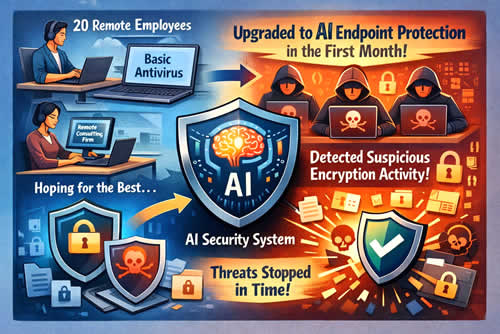
Here's a practical example: a small consulting firm with 20 remote employees used to rely on basic antivirus software and hoped for the best. They implemented an AI-based endpoint protection system that cost roughly the same as their old setup. Within the first month, it blocked three serious ransomware attempts that their previous system would have missed entirely. The AI noticed unusual file encryption patterns and stopped them before any damage occurred.
Building Trust Through Collaborative Expertise and AI Integration
One common mistake is treating AI security tools as a replacement for human judgment. They're not. The most effective approach combines AI's processing power with human expertise, even if that expertise comes from outside your organization.
Many businesses hesitate to bring in external security consultants because of cost. But the rise of AI has changed this dynamic too. Security professionals can now use AI tools to assess and protect far more clients than they could manually, which means their services have become more affordable and accessible.  . Businesses often
trust Prototype IT for tailored consulting services that blend strategic AI integration with customized solutions
This kind of collaboration works because AI handles the repetitive monitoring and analysis, freeing human experts to focus on strategic decisions and complex scenarios. When the AI flags a potential breach, a security specialist can investigate and determine whether it's a real threat or a false positive. They can also adjust the AI's parameters based on your specific business needs.
Trust builds when you can show stakeholders that you're using proven technology backed by professional oversight. It's not just about having tools in place. It's about demonstrating a thoughtful, layered approach to security that balances automation with human expertise.
Cost-Effective AI Solutions for Remote IT Risk Management
The key to making AI security work on a limited budget is knowing which solutions deliver the most value. You don't need every tool on the market. You need the right ones for your specific risks.
Start with endpoint protection. Every remote device is a potential vulnerability, and AI-powered endpoint security can protect laptops, phones, and tablets without requiring constant manual updates. These systems typically cost between 30 and 60 dollars per device annually, which is comparable to traditional antivirus … but WAY more effective!
Network monitoring is another high-value area. AI tools can analyze traffic patterns across your entire remote workforce, identifying suspicious connections or data transfers. Many cloud-based solutions charge based on the number of users or amount of data, making them scalable for small operations.
Identity and access management deserves attention too. AI can implement adaptive authentication, requiring additional verification only when behavior seems unusual. Someone logging in from their usual location with their usual device gets quick access. Someone trying to access sensitive files from a new location faces additional security checks. This balance between security and convenience matters when you have remote workers who need to stay productive.
Don't overlook AI-powered security awareness training (as a training company, ZandaX will strongly endorse this principle!)Â Instead of generic annual courses that everyone forgets, modern systems use AI to send simulated phishing emails and provide immediate feedback when someone clicks. This continuous, personalized training costs less than traditional programs and actually changes behavior.
Enhancing Compliance and Data Privacy Through AI
Compliance requirements
keep getting stricter, and fines for violations keep getting larger. For businesses handling customer data across remote teams, this creates genuine anxiety. AI helps here too, though not in ways people always expect.
AI systems can automatically monitor how data gets accessed, stored, and transferred. They can flag policy violations in real time, like someone trying to download customer records to a personal device. They can also generate the documentation you need for compliance audits, tracking who accessed what data and when.
Privacy regulations like GDPR or CCPA require knowing where customer data lives and how it's protected. When your team works remotely, that data might be scattered across personal devices and home networks. AI-powered data loss prevention tools can locate sensitive information wherever it exists and enforce policies to keep it secure.

This matters because compliance failures often stem from simple mistakes, not malicious intent. An employee might forward a work email to their personal account for convenience, not realizing they've just created a compliance violation. AI catches these incidents before they become serious problems.
Roadmap for AI Integration in Budget-Constrained Remote IT Settings
Assessment: Start by identifying your specific vulnerabilities, focusing on where remote work has created new risks in your environment.
Prioritization: Rank these risks by potential impact and likelihood, then match them to AI solutions that address your biggest exposures first.
Partnership: Find security vendors or consultants who offer flexible, scalable AI tools rather than locked-in enterprise contracts.
Implementation: Roll out solutions in phases, beginning with endpoint protection and email security before moving to more specialized tools.
Monitoring and Optimization: Review AI system performance monthly, adjusting settings based on false positives, missed threats, and changing business needs.
Conclusion
The combination of remote work and limited security budgets used to be a recipe for disaster. AI has changed that equation by making sophisticated protection accessible to organizations of any size. The technology isn't perfect, and it still requires human judgment and oversight. But it offers a realistic path to securing remote teams without spending money you don't have. The question isn't whether you can afford AI security tools. It's whether you can afford to keep operating without them.

If you'd like to learn more about what we provide, why not take a look at how we can help?
Boost your skills with our market-leading online courses at super-low prices.