Sarah stared at her cafe's profit and loss statement, confused. The bottom line showed a profit, yet her bank account was nearly empty. Sound familiar? Well, she's not alone – thousands of business owners struggle to make sense of their P&L, missing crucial insights that could transform their financial performance.
The profit and loss (P&L) account tells you whether your business actually makes money. Not whether you have cash (that's a WHOLE different story…) but whether your fundamental business model works. Once you understand what these numbers really mean, you can spot problems before they become disasters and find opportunities others miss.
This ZandaX article looks at the Profit and Loss Statement, how you can see how things are going in your business, and how to improve them to make more money.
NOTE: We’ve kept this as simple as we can, but if you want more clarification on any terms or concepts, see the list of articles (including a couple of jargon busters) at the end of this article.

General Accounting Concepts
Profit Isn't Cash (And Why That Matters)
Let's start with Sarah's confusion about profit versus cash. Her P&L showed $8,000 profit last month, but her bank balance had barely moved. The explanation was simple once she understood how accounting works.
Her P&L recorded sales when customers received their coffee and food, not when they paid. Sure, most customers were people who paid when they picked up their coffee (and hopefully biscuits or cakes…) But several corporate clients who'd held events at her café hadn't settled their invoices yet. Meanwhile, she'd paid cash for a new coffee machine that would last years – but only one month's worth of depreciation hit the P&L.
Profit measures whether you're selling things for more than they cost you. But
cash tracks whether money has actually changed hands.. Which is, of course, pretty important…
This distinction matters because each tells you something different about your business health. You might be wildly profitable but fail because you run out of cash. Or on the other hand, you might have loads of cash from retail customer receipts while heading for a loss (unpaid rent, maybe?)
How Accounting Actually Works
Accounting captures this through a clever system where every transaction affects multiple areas.
Sell a product? Revenue goes up, and either cash increases or someone owes you money.
Buy supplies? Expenses rise, and cash goes down, or you owe someone. This interconnected web creates a complete financial picture, with your P&L showing the profitability slice of that picture.
The timing of when you record things shapes everything. Most businesses use accrual accounting, which means recording income when earned and expenses when incurred, regardless of payment timing. This approach reveals whether you're genuinely making money rather than just tracking cash movements.
The Profit & Loss Statement
Your P&L starts with revenue – all the money earned from doing what your business does. Not from selling old equipment or getting a tax refund, but from your actual trade.
Breaking Down the Numbers
Here's where it gets interesting. Imagine
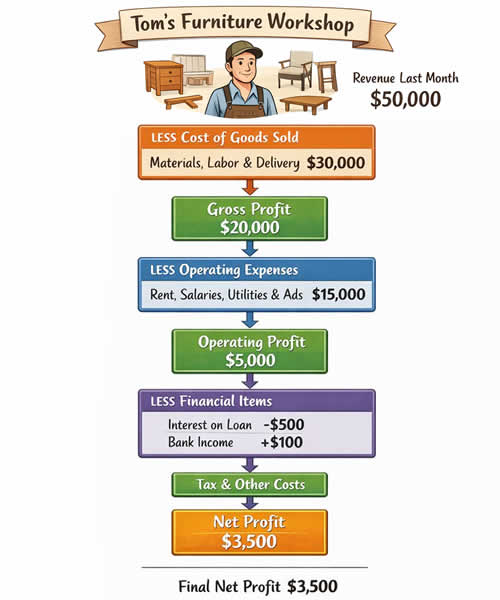
Tom runs a furniture workshop. His revenue last month was $50,000. Impressive, right? But that number alone tells us absolutely nothing about whether he’s been a success.
Next comes cost of goods sold – what Tom spent directly making those furniture pieces. Wood, varnish, workshop staff wages, and delivery costs totalled $30,000. Subtract that from revenue and Tom has $20,000 gross profit. This gross profit funds everything else in the business.
Now for operating expenses. Tom's showroom rent, office manager salary, advertising, insurance, and utilities added up to $15,000. These costs exist whether he sells one table or fifty. After deducting operating expenses, Tom has $5,000 operating profit.
But we're not done. Tom paid $500 interest on his business loan and received $100 from his bank deposit. After these financial items and taxes, his net profit was $3,500.
What Each Line Really Tells You
Each layer tells Tom something different. That 40% gross margin ($20,000 divided by $50,000) shows his pricing and production efficiency. But his 7% net margin reveals the full picture – decent but not spectacular. The question becomes: which numbers can Tom improve?
Well, raw numbers only tell half the story. The magic happens when you convert them to percentages and track changes over time.
Measuring Performance
Spotting Trends and Warning Signs
Take
Tom's furniture business. By analyzing six months of P&Ls, he noticed his gross margin had slipped from 45% to 40%. Small change? That 5% drop meant $2,500 less profit on $50,000 sales. Investigating further, he discovered his timber supplier had sneakily raised prices twice while Tom kept charging customers the same amount.
Sarah's café revealed different patterns. Her gross margin stayed steady at 70% (typical for food service), but operating expenses had crept from 60% to 65% of revenue. The culprit? She'd hired extra staff for an expected summer rush that never materialized. Those idle hands cost her dearly.
These percentages become powerful when compared against industry standards. If typical furniture makers achieve 50% gross margins while Tom manages 40%, he's either underpricing, overpaying suppliers, or working inefficiently. This gap represents opportunity.
Digging Deeper Into Your Numbers
Breaking down your P&L by product line transforms decision-making. Sarah discovered her artisan sandwiches generated 80% gross margin while coffee only managed 60%. Yet she'd been promoting coffee heavily because everyone told her "that's where cafés make money." The numbers said otherwise.
Tom's analysis went deeper. His custom pieces earned $100 per hour of labour while standard products only generated $40. The path forward became obvious – focus on custom work and let competitors fight over low-margin standard furniture.
Watch for trends that signal trouble ahead. Declining gross margins often mean competitors are forcing prices down or suppliers are squeezing you. Rising overhead percentages suggest bureaucracy creeping in. Wild swings between months indicate poor planning or over-dependence on few customers.
Using Your P&L for Better Decisions
Your P&L also guides growth decisions. Sarah knew her monthly overheads were $6,500. With a 70% gross margin, she needed $9,300 in sales to break even. To earn $3,000 profit (her mortgage payment), she needed $13,600 in monthly sales. This clarity helped her decide whether to open Sundays – would those extra hours generate $3,400 in sales to make it worthwhile?

The statement becomes even more valuable when you use it for "what-if" scenarios. What if Tom raised prices 10%? If he lost no customers, profit would jump 25%. But what if he lost 20% of customers? Running these numbers helps make brave decisions with confidence.
Don't ignore seasonal patterns. Many businesses panic during slow months, cutting costs that damage their ability to serve customers when busy times return. Your P&L history shows whether that January downturn is normal or concerning.
Red flags jump out when you know where to look. Customer concentration becomes obvious when losing one client would slash revenue 30%. Deteriorating payment terms appear as growing receivables relative to sales. Lifestyle creep shows up in mysteriously rising "miscellaneous" expenses.
Summary
The most successful business owners review their P&L monthly, not annually. They set targets for key percentages and investigate whenever reality diverges from plan. They ask uncomfortable questions about underperforming areas instead of focusing only on winners.
Your profit and loss account is trying to tell you something. It might be warning that margins are shrinking, revealing that certain customers actually cost you money, or showing that small pricing tweaks could dramatically boost profits. But these messages only matter if you're listening.
Understanding your P&L transforms it from compliance paperwork into a navigation tool. You'll spot opportunities faster, avoid problems earlier, and make decisions based on evidence rather than instinct. The businesses that thrive don't just make profits – they understand exactly how and why those profits arise, then deliberately create more of them.
Would you like a copy?
We hope you find it useful!

If you'd like to learn more about accounts and finance, why not take a look at how we can help?
Boost your understanding of accounts with our online courses.
RRP $65 – limited time offer just
$23.99