Cash flow is a constant pressure in all areas of business – but for small and medium sized companies in particular.
You may be an accountant, or have accounts responsibilities, or simply be a business owner or manager who just wants to get on top of a problem. And looking at the title of this article, you may be tempted to ask,
“
So how can analyzing my balance sheet help improve my company's cash flow?”
Well, this ZandaX article takes up the challenge to explain how the balance sheet helps diagnose cash flow issues in a small business ... and provide a simple but effective
Cash Flow Action Plan to focus your work.
Cash flow problems don’t usually announce themselves with a dramatic bang. They creep in quietly. One month you’re fine, the next month you’re juggling supplier payments, watching the bank balance too often, and wondering how a business that’s clearly selling can still feel so tight.
That’s the first big mindset shift:
cash flow and profit are not the same thing. Profit is what’s left after costs, on paper, across a period of time. Cash flow is whether the money you need is actually in your account at the moment you need it.
If you want a simple way to understand what’s happening, your balance sheet is the place to start. Not because it’s perfect. Not because it predicts the future. But because it tells you what’s true right now - and cash flow is mostly about what’s true right now. And if you’re under any kind of cash pressure, we’ll show you how you really can fix cash flow problems using a balance sheet!

If you'd like to learn more about accounts, we've got a couple of jargon busting articles that will help:
Anyway, let'swalk through it
in plain English.
Within the first few lines of your balance sheet, you can spot the most common reasons businesses feel “busy but broke”. You can also see the warning signs early, long before the business hits panic mode.
Why The Balance Sheet Is A Cash Flow Tool
(Even though it doesn’t look like one)
A balance sheet is a snapshot taken on a specific date. It shows what your business owns (assets), what it owes (liabilities), and what’s left over for the owners (equity).
That sounds like a bookkeeping definition, but here’s why it matters for cash flow: the balance sheet holds the clues about timing.
When cash flow is healthy, it’s usually because the business can turn its day-to-day activity into cash quickly. When cash flow is unhealthy, it’s usually because money is getting stuck somewhere - stuck in unpaid invoices, stuck in stock, stuck in work in progress, or committed to bills that land before the cash comes in.
The balance sheet shows exactly where that “stuck money” is sitting.
Start With Cash, Because It Doesn’t Lie
Most balance sheets list cash near the top of the assets section. This is the number that tells you what your business can do without borrowing, hoping, or negotiating.
Cash is brutally honest. It doesn’t care that you had a brilliant sales month. It doesn’t care that you’ve delivered great work. It only answers one question: how much room do you have right now?
A useful habit is to glance at cash and immediately think about what’s coming due in the near term. If you’re looking at the balance sheet monthly, even a rough mental check helps: wages, rent, VAT, supplier payments, loan repayments. You’re not trying to be precise — you’re trying to see whether the business is operating with comfort or operating on a tightrope.
 Scenario: profitable, growing, and still stressed
Imagine a small training company that sells corporate courses. It’s doing well. The owner is landing new clients and the profit figure on the P&L looks encouraging. But the balance sheet tells a different story: cash is low, while unpaid customer invoices are high.
What’s happening? The company is selling — but it’s selling on terms. Clients pay in 30, 45, sometimes 60 days. In the meantime, the business pays subcontractors and software costs monthly.
Nothing is “wrong” with the product. The cash pressure is coming from timing. And the balance sheet is showing you that without any drama, just by listing cash and unpaid invoices side by side.
Once you notice that pattern, you stop guessing. You can take action.
The Real Cash Flow Culprit: Money Owed To You
On the balance sheet, customer invoices waiting to be paid sit under assets, often called
accounts receivable or
debtors. This is where many cash flow problems live, because it’s where a business can look healthy on paper but feel weak in the bank. If your receivables are growing month after month, it usually means one of three things. You may have started selling more on credit. You may have customers paying more slowly. Or your invoicing process is lagging behind the work you deliver.
But the total receivables number is only the start. What matters is the quality of it. Are those invoices mostly recent, likely to be paid soon? Or is a chunk of it older, disputed, or coming from one client who always delays? If you can’t turn receivables into cash reliably, they’re not really supporting your business. They’re just sitting there as an optimistic number.
This is why cash flow improvements often start with boring but powerful changes: invoicing sooner, being clearer about payment terms, setting expectations before the work begins, and chasing late payments in a consistent, calm way.
And it’s not about being aggressive. It’s about running a business that isn’t forced to provide finance to its customers!
The sneaky cash trap: stock and work-in-progress
Inventory is another balance sheet line that deserves a second look. Stock is recorded as an asset, which can make it feel like a good thing. But stock isn’t cash. It’s cash that has been converted into something you hope will sell.
In retail, this is obvious. In other businesses, it hides under different labels. A trades business can have materials sitting on site. A web agency can have half-finished projects. A repair shop can have jobs part-way through. A manufacturer can have work in progress. It’s all the same pattern: money has left your account (don’t forget the wages and rent you’re paying out every day), but it hasn’t yet come back.

Sometimes that’s normal. You need stock. You need to start projects before you can finish them. The issue is when those numbers creep up while cash falls.
If your balance sheet shows rising inventory or work in progress alongside shrinking cash, your business is telling you it’s tying money up for too long. And when money is tied up, you lose flexibility. You stop making decisions based on what’s best and start making decisions based on what you can afford this week.
Now Flip To Liabilities: The Bills That Create Pressure
Current liabilities are what your business owes in the near term. Supplier bills, VAT, payroll liabilities, credit cards, short-term loan repayments — they all sit here. This part of the balance sheet matters for cash flow because current liabilities don’t care about your intentions. They care about dates.
A common “silent killer” is tax. Tax liabilities can build up quietly in the background and then arrive like a shock, even though they shouldn’t have been a surprise at all. The balance sheet keeps you honest about that. If those liabilities are rising, you know the bill is forming.
And sometimes the issue isn’t that liabilities are high. It’s that they’re badly timed. You might have several large payments landing in the same week, while customer cash arrives the week after. That gap can create a cash crunch even in an otherwise stable business.
Scenario: When “tax money” isn’t really your money
Javier runs a growing home services business with eight staff. Work is strong and the business is profitable, so he assumes cash flow is fine.
But sales tax and payroll taxes quietly build up in the business account. And because the money sits there alongside everything else, it just looks like cash.
Then the timing bites. Payroll is due on Friday, a large supplier invoice on Monday, and a quarterly estimated tax payment is due the following week – and although two big customers are set to pay, it will be
after those bills land. Nothing is unexpected. The business isn’t failing. But Javier is suddenly short of cash because the outgoings have fixed dates and the incoming cash arrives later.
When he later checks the balance sheet, the issue is obvious: those tax amounts were there alright, under current liabilities. The business looked cash-rich, but some of that cash was never really available to spend.
The balance sheet won’t fix timing for you, but it will show you the pressure building, which is what you need before you can plan sensibly.
Getting "Cash Safety" From Your Balance Sheet
You don’t need to turn this into a maths exercise. But there’s one relationship worth understanding because it captures cash risk in a single glance: the gap between current assets and current liabilities.
If your business has plenty of current assets and relatively low current liabilities, you have breathing room. If current liabilities are close to (or higher than) current assets, the business is running tighter. It may still be fine - but it’s more vulnerable to late payments, a quiet month, or an unexpected cost.

Accountants use all sorts of balance sheet metrics to reveal cash flow problems in a business (and more besides). To focus on our discussion, let’s look at
four survival metrics worth knowing. These quick checks tell you whether the business is comfortable, tight … or maybe at risk.
1. Working capital shows "breathing room"
current assets – current liabilities.
Positive means you can probably absorb shocks. But
negative means you’re relying on perfect timing - and even one late payment can hurt. But although it’s often the first place to look for a general view, it’s a bit of a lazy option because it doesn’t look at the detail.
2. Current ratio is your "stress gauge"
current assets ÷ current liabilities.
This is derived exactly from working capital: above 1 means your current assets are greater than you current liabilities. But the following metrics are more useful.
3. Quick ratio ignores inventory
(current assets – inventory) ÷ current liabilities.
By ignoring inventory, it measures your ability to use non-inventory assets to meet short term demands. This means that you may need to chase customers for money, but this is all part and parcel of day-to-day operation for most businesses. In essense, it answers the blunt question: can you pay short-term bills without needing sales of inventory to provide a boost? It’s likely the most practical option to use.
4. Cash ratio is your "holy grail" measure
(cash) ÷ current liabilities.
OK, so this is often a bit “pie in the sky” … if it’s greater than 1, it means that you have enough cash to pay all your immediate debts without worrying about receiving payments or selling inventory. But if you’re in this fortunate (sorry, hard-earned) position, you are in very good shape.
In practice, you should look at this, and see how close you can get to the magical position of 1.
By monitoring these metrics, you will change how you react. Instead of waiting for the bank balance to scare you, you can see the conditions that create cash scares … and act accordingly.
Turning What You See Into Action
So with the help of your ratios, you’ll take a look at your balance sheet. And here you’ll be able to see where the cash is getting stuck.
If
receivables (i.e.
debtors) look high ("HOW much am I owed???") your focus is customer payments.
If
inventory (or maybe
work in progress) is the issue, the focus is turnaround time.
If
liabilities are the issue, the focus is planning and spacing.
None of this requires fancy tools. It requires visibility. And the balance sheet gives you that visibility.

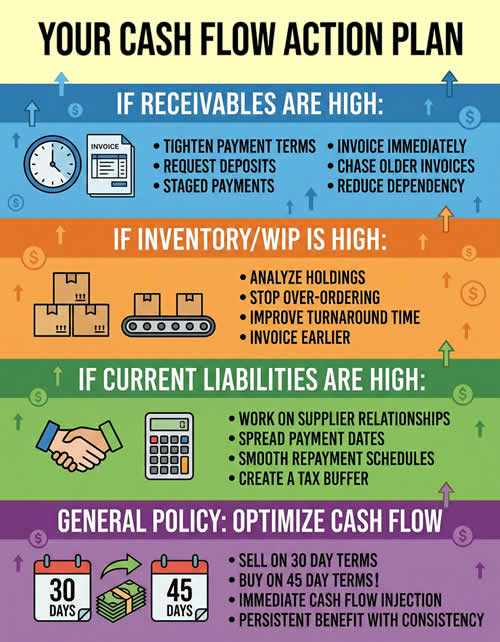
Your Cash Flow Action Plan
If you’re familiar with our articles, know that at ZandaX, we believe in stripping away jargon and complexity. People want quick, practical solutions to problems – and cash flow can be one of the most fearsome – and regular – problems that businesses face.
In this spirit, here’s a simple action plan that, having identified the weak spot … or spots … you can adapt to your own situation and use.
If
receivables are high:
- Tighten payment terms
- Request deposits for new clients
- Introduce staged payments for larger projects
- Invoice immediately, not weekly, or "when you get around to it".
- Chase older invoices sooner
- Reduce dependency on big slow-paying clients
If
inventory/work in progress is high:
- Look at how much you hold, as opposed to how much you actually need.
- Stop over-ordering "just in case"
- Improve turnaround time on projects
- Raise invoices earlier or in stages
If
current liabilities are high:
- Work on supplier relationships for better terms
- Spread payment dates
- Smooth (or lengthen) any repayment schedules
- Create a tax buffer
Finally, a
general policy that applies to any business doesn’t occur to many people, or if it does, they don’t actually follow through.
This is to sell on 30 day terms and buy on 45 day terms: it gives your business an immediate cash flow injection that persists … as long as you keep up the policy. That must be worth thinking about, especially when many businesses are often, without realizing it, working the other way around.
This is how your balance sheet becomes more than a report. It becomes a decision tool!
The Point Isn’t to Become an Accountant
You don’t need to love financial statements to run a financially strong business. You just need to be able to read the signals. And the balance sheet is one of the clearest signal boards you have. It tells you whether cash is truly available, whether you’re leaning too heavily on unpaid invoices, whether money is tied up in slow-moving stock or long projects, and whether near-term obligations are starting to crowd you.
When you get used to scanning it, cash flow stops feeling mysterious. It becomes something you can influence. And that’s the goal: not perfection, not paperwork — just a business that’s stable, predictable, and able to make decisions from a position of strength.
And, to conclude, we hope that, however skeptical you may have been at the start, if you take the time to read and absorb what we say – or even just use our
Cash Flow Action Plan – you will agree that you can, actually, fix cash flow problems using you balance sheet…
Would you like a copy?
We hope you find it useful!

If you'd like to learn more about accounts and finance, why not take a look at how we can help?
Boost your understanding of accounts with our online courses.
RRP $65 – limited time offer just
$23.99