OK, first off, let’s get a couple of definitions out of the way.
Managed Service Providers (MSPs) are companies that run and support IT systems for their clients. They are multi-functional, often taking care of networks, endpoints, cloud services, and security which means that internal teams don’t need to do everything themselves.
In regulated sectors like finance, healthcare, and energy, MSPs also help their clients meet strict rules on data protection, uptime, and reporting. This also keeps costs predictable and expertise readily accessible.
Regulated industries are those where governments or regulators impose strict rules because failure can cause harm to people or the wider economy. Banks, hospitals, insurers, and utilities all fall into this category, and they must follow frameworks like GDPR for data privacy, HIPAA for health information, and so on.
For MSPs serving these clients, security and compliance are inseparable. And if systems aren’t secure, they
won’t stay compliant for long.

The Growing Complexity of Compliance in Regulated Sectors
Compliance has become a whole lot more difficult as organizations move to the cloud, connect more third parties, and collect more data. Rules are also changing faster, with new data protection, AI, and cybersecurity requirements being introduced or updated on a regular basis. MSPs are expected to understand all of this, prove that controls are in place … and react quickly when something changes.
One of the key innovations in this space is the emergence of platforms like
mandrytechnology.com, which integrate AI-powered compliance monitoring with workflow automation that's tailored specifically for MSPs in these environments.
For MSPs themselves, the challenge is twofold: they must maintain their own compliance as well as helping each client satisfy different frameworks and auditors. A single gap - like missing logs, excessive access rights, or outdated policies - can lead to fines, contract loss, and/or reputational damage for both the client and the provider. This is the backdrop against which AI has started to play a much larger role.
The Role of AI in Enhancing Compliance Management
AI-driven tools can scan large volumes of operational and security data, highlight anomalies, and automate some of the evidence-gathering work that used to consume huge amounts of human time. For example, AI can compare log data, tickets, and configuration information against required controls and flag where something is missing or inconsistent before an audit finds it.
These systems use techniques such as machine learning and natural language processing to understand both structured data (like access logs) and unstructured data (like policies and regulatory updates). This lets MSPs move from periodic, manual checks to continuous monitoring, where alerts appear as soon as they see drift from the required standard. Some platforms even map controls across multiple frameworks automatically, helping MSPs support clients that need to comply with several regimes at once without doubling up on effort.
Integrating AI into MSP Services: Key Benefits
When MSPs integrate AI into their security and compliance services, several advantages show up quickly:
- Better risk detection: AI can recognise subtle patterns that suggest misuse or non-compliance, such as unusual login behaviour or unexpected data transfers, and flag them up for human review.
- Higher efficiency: Automated evidence collection, control checks, and report generation reduce manual work, letting teams focus on advising clients and improving architectures instead of chasing screenshots and exports.
- Real-time visibility: Continuous monitoring means MSPs and clients see their compliance posture in near real time, instead of waiting for quarterly or annual reviews.
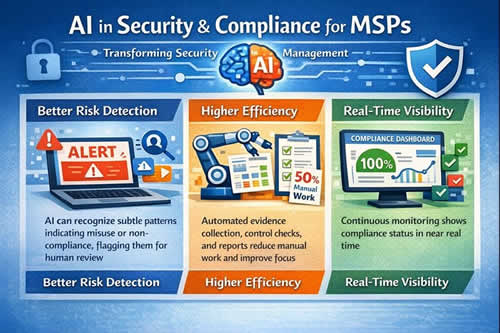
Vendors in this space report that AI can cut the labour involved in some compliance tasks by more than half, particularly around audit preparation and ongoing control testing. For regulated clients, that’s incredibly useful because it can translate into faster audits, fewer findings, and a clearer sense of where their biggest risks actually sit.
Cloud Security and the Principle of Least Privilege
As MSPs move more workloads into public and multi-cloud environments, access control has become one of the most important parts of compliance. Most modern frameworks and regulators expect organizations to follow the “least privilege” principle: every user, service account, and integration should have only the access it genuinely needs, and nothing more.
Implementing
cloud least privilege strategies helps MSPs mitigate risks in cloud environments. By combining AI-driven monitoring with a policy of least privilege access, they can create a robust position that protects sensitive data and meets regulatory demands.
AI can help here by analysing permissions, roles, and real-world usage patterns to spot excessive or unused access and recommend tighter policies. Some can automatically adjust privileges, revoke dormant accounts, or trigger reviews when a high-risk permission is granted. Studies of organizations that combine least-privilege strategies with automated, AI-driven monitoring show big reductions in incidents tied to misuse or over-privileged accounts.

If you'd like to learn more about what we provide, why not take a look at how we can help?
Boost your skills with our market-leading online courses at super-low prices.
Overcoming Challenges in AI Adoption for MSPs
Despite the benefits, AI adoption brings its own challenges. AI tools are
only as good as the data they see, so MSPs must make sure that logs, asset inventories, and configuration data are complete and trustworthy. Poor data quality leads to false positives, blind spots, or misleading dashboards … which can undermine confidence and waste time.
Skills are another constraint. MSP staff need enough understanding of both compliance requirements and AI capabilities to interpret results, explain them to clients, and tune systems as required. Regulators are also starting to want explainability: MSPs should be able to show how AI reached certain conclusions, what was reviewed by humans, and where final accountability lies. All of this requires investment in training, process, and governance; just “tooling up” isn’t anywhere near enough.

The Future: AI as a Compliance Partner
Looking ahead, AI is likely to move from being a helpful add-on to a core part of how MSPs deliver security and compliance services. Existing tools already help organizations anticipate regulatory changes, simulate the impact of new rules, and test their resilience to different incident scenarios.
For decision makers, the key point is that AI doesn’t replace accountability - it augments it. MSPs that adopt AI thoughtfully, with strong data and clear governance, can give their clients faster understanding of their risk, fewer nasty surprises at audit time, and more time to focus on their core business instead of constant firefighting. Those that ignore it risk being left with higher costs, slower responses, and services that no longer match what regulators and customers expect.
how-to-use-ai-to-boost-cloud-infrastructure-compliance-for-regulated-industries