AI search tools now shape how decision-makers discover and evaluate organizations. ChatGPT, Copilot, Google Gemini, Perplexity, Claude, and Meta AI – among others – have reshaped how marketers should develop their own brand reputation.
This ZandaX review maps where each platform sources brand information, audits content for accuracy and tone, and benchmarks competitors across the same channels.
It also clarifies how sentiment forms, where gaps can be corrected, and which measurable steps maintain visibility and trust over time.
What AI-Driven Reputation Actually Means
AI-driven reputation refers to how six major platforms find, and assess, your brand. This means that a
free reputation consultation that once focused on traditional media must now also examine ChatGPT, Gemini, Claude, Perplexity, Meta AI, and Copilot. And it must present and rank entities within their generated answers. Each of these systems draws on different training data and real-time sources, so your brand can appear prominently on one platform and be completely absent on another.
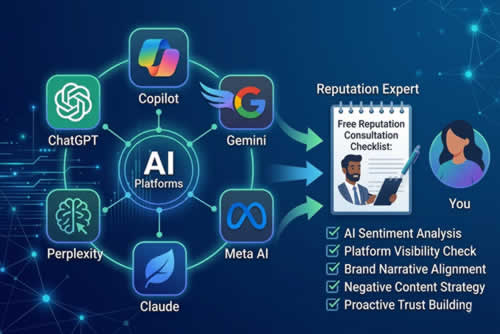
A consultation starts with two phases. First, consultants map your current presence by querying each platform about your brand, leadership team, and key offerings. Second, they measure brand sentiment by examining how these systems describe your organization. This structured approach reveals gaps that traditional search monitoring alone cannot uncover.
AI answers now influence a significant share of zero-click decisions, where users receive information directly from a generated response without visiting any website. The consultation identifies which platforms surface your brand most frequently and which ones overlook you entirely.
The most useful single KPI guiding these consultations is the AI Visibility Score, calculated monthly. This metric tracks how often and how favorably each of the six platforms references your brand across different query types. Monthly tracking reveals trends and helps prioritize which efforts will move the needle most.
How Each Platform Sources Brand Information
Three criteria determine
visibility across platforms: the model's training data cutoff date, whether it has real-time web access, and how it handles citations.
These factors create very different coverage patterns. ChatGPT-4 operates with an April 2023 cutoff. Claude 3 uses an August 2023 cutoff. Copilot maintains continuous access through Bing. Gemini continuously connects to Google Search. Perplexity operates with continuous web access.
ChatGPT and Copilot
ChatGPT defaults to GPT-4 with no live browsing unless the Browse with Bing toggle is enabled, which limits citations to its April 2023 training corpus. A query like "Acme Corp revenue 2024" returns training data only unless that toggle is active. Copilot, by contrast, sources three reference links at the bottom of responses and benefits from Bing's continuous indexing.
Brands benefit from strong pre-2023 content that stays accessible even without real-time browsing. The toggle dependency is a real risk for companies that have undergone rebranding, leadership changes, or reputation events after that cutoff date.
Gemini and Perplexity
Gemini pulls from the Google Search index and Knowledge Graph, and often sources Knowledge Panel data during brand queries. Perplexity combines web search with source footnotes in every answer, listing multiple live URLs with clear attribution.
Optimization tactics differ between these two. Updating a Google Business Profile improves Gemini visibility. Securing backlinks from educational or government domains helps Perplexity surface content more readily. Brands need consistent presence across both Knowledge Graph entries and live web citations.

Claude and Meta AI
Claude 3 and Meta AI both rely on static training data with no native real-time retrieval. Claude 3 operates with a March 2023 cutoff. Meta AI uses a September 2023 cutoff. Neither system pulls fresh information during standard queries.
Pre-training content placement becomes the primary lever here. High-authority sources like Wikipedia and major news outlets frequently enter training sets. For brands pursuing visibility on these platforms, authoritative third-party mentions matter more than recently published owned content.
Running a Content Audit Across All Six Platforms
A content audit means querying identical brand prompts across all six platforms and logging the exact text, sources, and sentiment returned. This step forms the diagnostic core of any free reputation consultation.
Start by creating 10 standardized prompts that pair the brand name with terms like "review," "founder," "controversy," "revenue," and "competitor." Submit each prompt to ChatGPT, Gemini, Claude, Perplexity, Grok, and Copilot. Record every response in a shared spreadsheet with columns for platform, date, sentiment score (from -1 to +1), sources listed, and citation accuracy.
Cross-check social sentiment using a tool like Brandwatch to identify gaps between public conversation and the narratives generated by these models. Flag hallucinated facts by comparing AI statements against primary sources and company records.
Score consistency across the six platforms on a scale from 1 to 10. A low consistency score signals that your reputation varies significantly depending on which AI a user happens to query. That variation is a risk worth addressing early.
| Platform |
Sentiment Score |
Sources Listed |
Citation Accuracy |
| ChatGPT |
+0.6 |
3 |
Mixed |
| Perplexity |
+0.9 |
5 |
High |
How to Measure Citation Accuracy and Sentiment
Citation analysis measures how frequently and accurately each AI platform references your brand with correct facts and appropriate framing. This is distinct from sentiment alone because a platform can mention your brand often while getting key facts wrong.
Three tools support this process:
- ai for detecting citation accuracy
- Brand24 for scoring sentiment levels
- Perplexity Source Tracker (Chrome extension) for mapping source attribution patterns
Monthly targets to work toward: 80 percent citation accuracy with sentiment above 0.4. The formula is: correct mentions divided by total mentions, multiplied by sentiment weight. One fintech company improved citation accuracy from 41 percent to 79 percent within 90 days by publishing primary data reports that AI platforms began referencing directly.
Benchmarking Competitors Across AI Platforms
Competitor benchmarking compares your AI Visibility Score and sentiment against three direct rivals using identical prompt sets. The comparison identifies where your brand stands across ChatGPT, Gemini, and Perplexity relative to companies competing for the same audience.
Select three competitors that match your industry and audience reach. Run the same 10 prompts across all six AI platforms for each company. Track results manually and with tools like Brandwatch.
| Avg Sentiment |
Citation Count |
Hallucination Rate |
Top Triggers |
| Acme (you) |
| 0.52 |
14 |
Low |
Product innovation / Pricing complaints |
| Competitor A |
| 0.71 |
22 |
Medium |
Customer service / Limited features |
| Competitor B |
| 0.34 |
9 |
High |
Brand recognition / Quality concerns |
When the sentiment gap between your scores and top performers exceeds 0.15 points, prioritize content on topics that trigger positive responses for those competitors. Address these areas within 60 days. Document which prompts generate the strongest reactions for each rival. That information directly shapes your generative engine optimization strategy.
The Remediation Plan: Three Levers That Actually Work
The remediation plan prioritizes three actions: increasing authoritative first-party content, securing third-party citations, and correcting negative AI outputs quickly through fact submission. Companies have built structured workflows around this process because the window between detecting a hallucination and correcting it matters more than most brands realize.
Publish quarterly primary research reports of at least 3,000 words that include original datasets. These documents establish expertise signals that AI models can reference directly. Focus on topics where your brand holds unique data or perspective.
Secure 12 guest posts on high-authority sites within 90 days. These placements create third-party validation that strengthens entity recognition across all six platforms. Guest content should align with your core expertise areas rather than broad topics.
Submit entity corrections within 48 hours of detecting a hallucination. Each platform has a feedback mechanism. Quick response times prevent incorrect information from spreading through conversational search results and knowledge panels.
Add FAQ schema targeting common query patterns that appear in AI-generated responses. Structured data helps models identify authoritative answers more reliably, and this markup also improves visibility in voice and multimodal search environments.
Build an entity home page incorporating structured data with at least 50 internal links. This central page serves as the authoritative source for your brand narrative. Internal links distribute authority signals that reinforce credibility across LLM citations and AI overviews.

If you'd like to learn more about what we provide, why not take a look at how we can help?
Boost your skills with our market-leading online courses at super-low prices.
Setting Up Ongoing Measurement
A consultation should establish a monthly measurement cadence using a reputation dashboard that tracks AI Visibility Score, sentiment, citation accuracy, and hallucination incidents across all six platforms. Without this, you are working from snapshots instead of trends.
Three tools support ongoing monitoring:
- Brand24 for daily alerts on new mentions
- A CustomGPT monitoring agent for weekly automated prompts across platforms
- Google Sheets API for pulling live scoring data into a single view
Set clear action thresholds. An AI Visibility Score below 40 triggers a remediation sprint. A sentiment delta greater than 0.2 compared to competitors signals the need for a content push. These thresholds keep the work focused rather than reactive.

Regular monitoring matters because AI platforms update their training data, adjust retrieval logic, and change citation behavior over time. What surfaces today may not surface six months from now. The brands that maintain strong AI search visibility are the ones that treat it as an ongoing practice rather than a one-time fix.