Clear communication isn’t a feel-good bonus - it's a productivity lever! Teams that share information well are 20–25 percent more productive, and 86 percent of executives say projects fail when collaboration breaks down. As a supervisor, you can’t afford guesswork. In this guide, we’ll show you five research-backed assessments - showing exactly when to use each one, how long they take, and the payoff you’ll see.
Ready to turn survey data into real-time performance gains?
Why You Need To Measure Communication
You can sense when a meeting goes quiet, yet the ledger proves the damage. Nearly nine in ten employees and executives link project failures to poor collaboration (see these communication-in-the-workplace statistics). Add the price tag: According to a 2022 Grammarly and Harris Poll study, U.S. companies lose $1.2 trillion a year, or roughly $12,500 per knowledge worker, because messages slip through the cracks.

The bigger risk hides beneath the surface. As leadership coach Darcy Luoma notes, assessments “reveal strengths and weaknesses and pave the way for genuine improvement.” In plain English, they surface the backstage scripts—unspoken norms, silent dissent, and pockets of power—that status reports miss.
When numbers replace hunches, momentum snaps back. Instead of debating personalities or replaying the last bad meeting, supervisors can see where
communication actually breaks down at the team level. One practical way to do that is to look at how a group communicates, processes information, makes decisions, and executes together, a structure used in team communication assessments developed by TeamDynamics. With that clarity, leaders can choose the right fix, whether that is tightening stand-up rhythms, clarifying decision ownership, or redesigning how updates flow, instead of funding another generic retreat.
Bottom line: assessments turn fuzzy feelings into an actionable dashboard, so conversations move work forward instead of circling the same problems.
How We Picked the Five Assessments
We reviewed more than 30 commercially available diagnostics and kept only the five that truly lighten a supervisor’s workload. Each finalist met four non-negotiable tests:
- Evidence over buzz. Tools must cite peer-reviewed research or show at least five years of documented organizational use.
- Communication focus. Reports need to reveal who speaks up, who stays silent, and how information flows; generic “teamwork” scores didn’t qualify.
- Built-in action. Clear next steps, such as debrief guides, coaching tips, or auto-generated action plans, had to accompany the numbers.
- Quick and affordable. Surveys must finish in under an hour and stay within a price a small team can realistically approve.
That filter left five standouts we’re highlighting here.
And let’s examine each tool more closely so you can choose with confidence.
1. Teamdynamics
See Your Team’s “Personality” as a Single Picture
What it is and how it works
Unlike individual-centric tools,
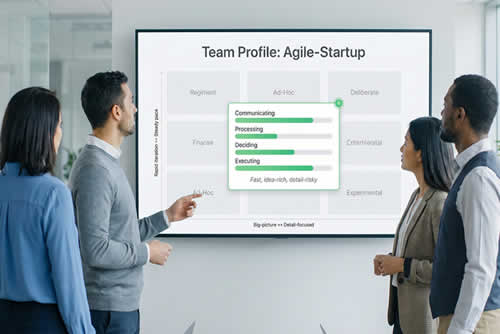
TeamDynamics measures the group as a whole. Each teammate completes a 15–30-minute survey, and the platform maps responses across four interaction dimensions: communicating, processing, deciding, and executing. The algorithm then assigns your crew to one of 16 validated team types, a model refined through 200-plus pilot teams in tech, healthcare, and finance.
Picture it as a team mirror. An Agile-Startup profile means ideas fly but details leak. A Regiment type signals bullet-proof hand-offs yet rigid brainstorming. With a shared label, you can discuss trade-offs without finger-pointing.
Why supervisors use it
- Gives the team a neutral vocabulary that lowers defensiveness in retros
- Generates an action guide with three to five experiments (e.g., rotating note-taker, 15-minute design huddle) so insights move straight into practice
Why supervisors value the insights
A shared vocabulary turns critique into conversation. When the report tags your team as Agile-Startup, the debate shifts from “Who talks too much?” to “How do we keep details from slipping through?” That neutral framing speeds up fixes.
Because results are collective, no one feels singled out. The story becomes “our workflow risks deadlines,” not “Alex missed a step.” Psychological safety rises; teams with high psychological safety are 20 percent more likely to report excellent performance.
The profile also sparks trade-off discussions you would usually delay. A Regiment team may notice its bullet-proof checklists stifle brainstorming, while an ad-hoc crew might adopt a simple status template. Most groups leave the debrief with two or three testable experiments instead of a vague plea to “communicate better.”
When TeamDynamics is the right call
Choose TeamDynamics when the friction is clearly collective. Telltale signs include projects slipping because updates scatter across Slack threads or meetings that drag on while decisions stay murky. These patterns reveal team-level habits the assessment can chart in one sweep.
Skip it if turnover is high and half the chairs rotate each quarter; the model needs a stable roster to tell a coherent story. When churn is heavy, an individual style lens such as DiSC delivers quicker traction.
Pricing is straightforward: one license per team, usually $1,200–$1,500 for a midsize group, with no per-head renewals. It is a practical pilot cost before you commit to pricier platforms.
Bottom line: when you need a people-friendly mirror on collective style, TeamDynamics delivers. If you need granular skill ratings or one-on-one coaching prompts, the next tools will serve you better.
2. Everything Disc
Translate Personalities Into Practical Communication Tactics
What it is and how it works
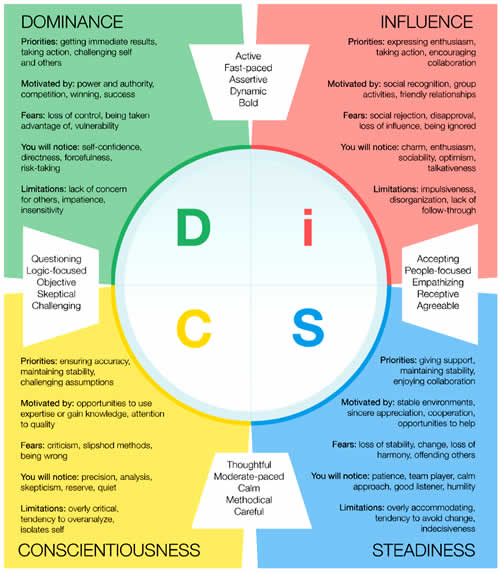
Everything DiSC turns the classic quadrant—Dominance, Influence, Steadiness, Conscientiousness—into an actionable communication map. Each teammate completes a 20-minute, research-validated questionnaire, and the platform plots every profile on a circular map to show whether the group clusters in one style or forms a healthy mix. More than one million learners a year take the assessment, and Wiley’s database now tops 10 million profiles across 70-plus countries.
The insight is concrete. A high-D colleague wants bullet-point briefs and quick decisions, while a high-S teammate values harmony and reflection time. If three quarters of your squad lean “C,” detailed documentation will land, but spontaneous brainstorming may need a nudge.
You receive an individual report and a team composite. Together, they flag who needs brevity, who craves context, and where friction hides, moving you from abstract personality chatter to specific, daily adjustments.
Why DiSC insights stick
DiSC neutralizes style differences. When the report notes that Maria leads with Influence, the team hears data, not criticism, and tense discussions cool quickly.
The vocabulary stays alive in meetings. You will hear, “Let’s give our C types the deck a day early,” or “We need a D in this meeting to break the tie.” Those shorthand cues flow straight into agendas, email length, and feedback tone.
Guidance comes built in. Each profile ends with practical do’s and don’ts, such as “With Dominance colleagues, open with the bottom line,” so supervisors do not have to invent coaching tips.
That clarity matters: organizations that roll out DiSC see up to a 30 percent drop in unproductive conflict within six months. When
communication clashes, DiSC gives everyone a shared language fast; if issues run deeper than style, the next tool tackles team-level behavior.
3. The Five Behaviors
Look at trust, conflict, and commitment in one sweep
What it is and how it works
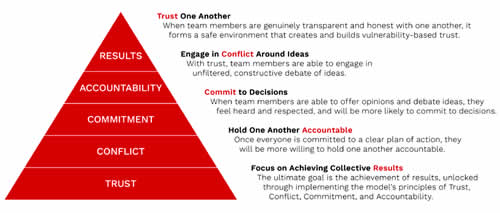
Patrick Lencioni’s pyramid lists five layers: trust at the base, then healthy conflict, commitment, accountability, and results. The book has sold more than three million copies worldwide, and The Five Behaviors assessment turns that framework into data your team can act on.
Each member rates 20–25 statements such as “We openly admit mistakes” or “We debate ideas without personal attacks.” The 25-minute survey rolls into a heat map that shows, row by row, where your group excels and where it wobbles.
- Low conflict scores flag artificial harmony, where people nod in meetings but vent later.
- Weak trust scores hint at guarded updates and reluctance to ask for help.
Because the tool maps all five layers, you see the causal chain: muted debate → fuzzy commitments → shaky accountability.
Most teams debrief results in a half-day workshop led by a certified facilitator and leave with a behavioral action plan, such as “agenda sent 24 hours ahead” or a “disagree-and-commit” check at meeting close. The payoff is real: 89 percent of learners say the program improved their team’s effectiveness.
Why the pyramid model lands with teams
Pictures stick. Roughly 65 percent of people are visual learners, and visual aids can boost retention by up to 42 percent. The pyramid gives everyone a mental model they can sketch on a whiteboard months later, which helps when habits slip under pressure.
Numbers remove guesswork. If the survey shows trust at 47 percent, no one can shrug and say “we’re fine.” The model also prioritizes fixes: shore up the base before tweaking accountability metrics.
Because the assessment measures behaviors, not traits, change feels doable. A low Conflict score is not destiny; it signals the need for norms like a rotating devil’s-advocate role each sprint. Teams leave the workshop owning the remedy instead of blaming personalities.
Use Five Behaviors when hidden tension slows decisions or when new leaders inherit a team with history. If budget or time will not stretch to a facilitated session, a lighter pulse tool can keep momentum without the full workshop.
4. 360-Degree Feedback
Get a full mirror, not a selfie!
What it is and how it works
Traditional reviews flow top-down and
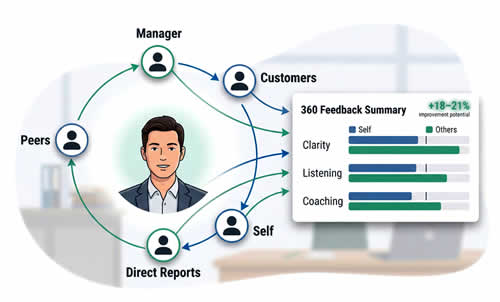
miss blind spots. A 360 widens the lens: direct reports, peers, and your own manager rate observable behaviors such as clarity, listening, and coaching. Some platforms even invite customers or dotted-line partners.
The survey is short—about 15 action-based statements (“Explains the ‘why’ behind decisions”). Respondents rate frequency and add anonymous comments. For supervisors who want a quick primer on structuring a communication skills assessment test for employees, this guide walks through question formats and scoring models. Software then compares self-ratings to external views, flagging gaps that matter.
Why does it help? In one meta-analysis, leaders who acted on 360 feedback improved effectiveness by 18–21 percent. A three-point gap between your self-score and your team’s view shows exactly where to focus, saving you from generic leadership classes.
Because ratings are aggregated and anonymous, people feel safer speaking up. You receive unfiltered truth in clean charts instead of hallway whispers.
Why leaders value the “tough-love” feedback
The first read-through can sting; hearing that you interrupt one-on-ones melts denial faster than any TED Talk. Yet leaders who face the discomfort climb quickly: another meta-analysis found that those who acted on 360 feedback improved performance by 15–21 percent within a year.
It is not punishment. Reports highlight strengths as well as gaps, so you double down on what works while closing what does not. Sharing your top takeaways with the team shows you live the feedback culture you preach, which boosts psychological safety.
Timing matters. Launch a 360 about six months into a role, long enough for colleagues to see real behaviors, and repeat 9–12 months later to prove progress.
Use a 360 when you suspect your own style—not the team’s system—is clouding clarity. Need a continuous sentiment pulse? The next tool automates that loop.
5. Culture Amp
Turn feedback into an always-on pulse
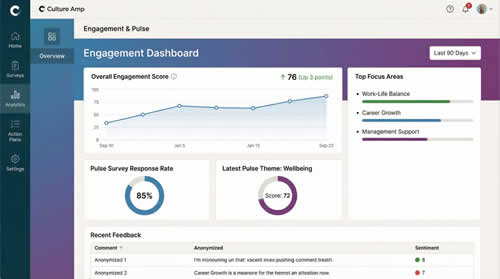
What it is and how it works
Think of Culture Amp as a dashboard for team sentiment. You start by sending a short survey (statements like “I receive information in time to do my job well.”). The cloud platform collects anonymous answers, converts them into heat maps, and highlights the top drivers of engagement. More than 6,000 companies worldwide use the tool, covering five million employees last year alone.
Because it is cloud based, you can run quarterly pulses without spreadsheets. Trend lines show whether your new stand-up format lifted the communication clarity score or if enthusiasm faded after launch. Industry benchmarks help you judge progress: if 78 percent of your team feels well informed while the sector average is 86 percent, you still have room to grow.
Why supervisors value the data drip
Timely numbers beat annual surprises. When a score dips, you can run a retro next week; no six-month wait. An action-planning wizard suggests proven fixes such as a town-hall Q&A or a shared roadmap doc, so improvements do not stall in committee.
Anonymous comments surface quiet voices. The teammate who rarely speaks on video can still flag “decisions change without notice,” giving you a precise gap to close.
Use Culture Amp when you want continuous visibility and have the discipline to act on every survey. If feedback piles up with no follow-through, trust erodes fast.
Putting The Pieces Together
No single assessment is a silver bullet. Real gains appear when you chain tools in a deliberate rhythm:
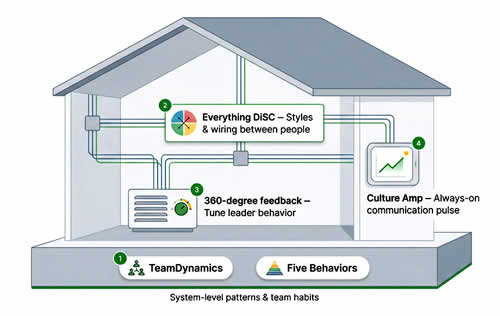
- TeamDynamics or Five Behaviors to map system-level patterns and land two or three quick wins, such as shorter stand-ups or clearer ownership logs.
- Everything DiSC to fine-tune one-to-one interactions within that new structure.
- 360-degree feedback to confirm whether your own habits amplify or undercut the shift; repeat after 9–12 months to track progress.
- Culture Amp runs quietly in the background to verify improvements each quarter and surface fresh gaps.
Picture a house: TeamDynamics and Five Behaviors pour the foundation, DiSC handles the wiring, a 360 tunes the climate control, and Culture Amp installs the smart thermostat that alerts you when the temperature drifts.
Conclusion
Clear communication is one of the few leadership levers that boosts speed, quality, and morale at the same time—but only if you can measure what’s actually happening, not what you think is happening. That’s why these five assessments matter: they turn vague frustrations (“we keep missing details” / “meetings are a waste” / “people don’t speak up”) into diagnosable patterns with repeatable fixes.
The smartest supervisors don’t pick one tool and hope for the best - they use assessments like a system:
- TeamDynamics or Five Behaviors to reveal team-level habits and unlock quick wins.
- Everything DiSC to reduce friction in day-to-day interactions and messaging styles.
- 360-Degree Feedback to confirm whether your own habits are helping or hurting clarity.
- Culture Amp to keep a steady pulse so improvements don’t fade after the first workshop.

If you'd like to learn more about managing staff, why not take a look at how we can help?
Boost your team management skills with our online courses.
RRP from $33 – limited time offer just
$14.99
In short: communication improves fastest when you stop guessing and start treating it like a performance metric. Pick the tool that matches your team’s real problem, run it, debrief it, and commit to two or three experiments … then measure again.
That’s how communication turns from “soft skill” into hard results!