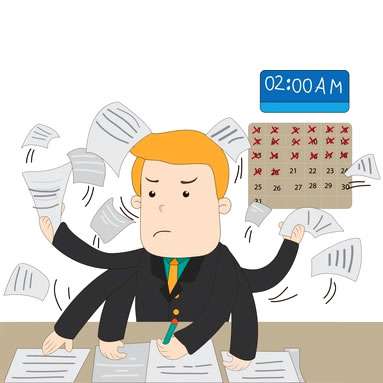
You sit down at 9am with a clear plan for the day. By 9:14am, you've answered three Slack messages, replied to an email marked urgent (it wasn't), and forgotten what you originally opened your laptop to do. Sound familiar? This is the modern working day for millions of people, and it's quietly destroying the quality of the work they produce.
Deep focus — sometimes called cognitive control — is the ability to stay locked on one demanding task without your attention being yanked away. It's the engine behind good writing, sound decisions, careful analysis, and creative problem-solving. And yet most offices are organized in a way that makes deep focus almost impossible to achieve. That's worth taking seriously, because the people who protect their attention are quietly outperforming everyone else.
 This ZandaX article looks at how focus – or a lack of it – affects performance, how it can be improved, from a management as well as a personal viewpoint.
Why Attention Is the Real Productivity Metric
There's a stubborn myth in business culture that being busy and being productive are the same thing. They're not. A person who replies to fifty messages in an hour looks responsive, but they may have produced nothing of value. A person who spends two uninterrupted hours on a difficult report has done something a machine can't replicate.
This situation may be helped by using a
busy light, which gives colleagues a polite way of knowing not to interrupt. And when you can give a task your full attention, you spot the small errors, you make the connections that matter, and you finish faster than the half-distracted version of you would have. But the opposite is also true. Every time your brain switches contexts — from spreadsheet to chat to email — it pays a small cognitive tax. Stack up enough of those taxes across a day and you've burned hours without realizing it.
This is why attention, not hours worked, is the metric that actually predicts performance.
The Multitasking Lie
If there's one thing most people get wrong, it's the belief that they're good at multitasking. Actually, almost no one is. What people call multitasking is usually
rapid task-switching. The research is unambiguous: it slows you down, increases errors, and leaves you mentally drained by mid-afternoon.
The fallout shows up everywhere. Mistakes in client documents. Decisions made on incomplete information. Meetings where everyone is half-listening because they're answering messages under the table. None of this is laziness or incompetence — it's the predictable result of asking the human brain to do something it isn't designed to do.

What's Actually Getting in the Way
The barriers to focus
are usually environmental rather than personal. Open-plan offices, marketed as collaborative, often produce a steady hum of conversations that fragments concentration. Digital tools designed to make communication easier have turned into a constant tap on the shoulder.
Consider Maria, a marketing manager in a mid-sized firm. She's responsible for the quarterly campaign plan, which needs three or four hours of clear thinking. But she's also expected to respond within minutes, attend two stand-up meetings, and field questions from her team. By Friday, the plan isn't finished, and she's exhausted from a week of starting and stopping the same work.
That's not a Maria problem. That's a system problem.
The Quiet Culture War Over Responsiveness
Here's where most articles on this subject tiptoe around the real issue. Many organizations talk a good game about deep work, but their managers still reward instant responsiveness. The person who replies to emails at 10pm gets praised. The person who silences notifications to finish a difficult task is seen as unreachable, maybe even uncommitted.
Until management stops treating availability as a proxy for dedication, no individual focus technique (or aid) will fully work. You can buy noise-canceling headphones and focus apps for the whole team. But if the boss expects a reply in three minutes, deep work isn't going to happen.
This is a cultural choice. And it ought to be made deliberately, not by default.

What Managers Can Actually Do
The people best placed to fix this aren't the employees — it's the managers. Block off meeting-free mornings. Tell your team explicitly that messages outside core hours don't need a reply. Model the behavior yourself by not pinging people at midnight. The signal travels faster than any policy document.
Practical Ways to Build Focus Back Into the Day
Once management is on board, the practical changes are pretty straightforward. Time-blocking — reserving specific chunks of the day for specific kinds of work — is one of the most effective habits. So is a morning routine that pushes the hard, thinking-heavy work to the front of the day, when attention is sharpest.
Here are the practices that tend to pay off most reliably:
- Protect two or three hours of uninterrupted work each day, defended like any other meeting.
- Use visible availability signals (a light – as we’ve mentioned – an “on-air” indicator, even a closed door) so colleagues know when to hold off.
Notice there are only two. That's deliberate. A long checklist of focus techniques quickly becomes another distraction!
Focus as a Skill You Train, Not a Trait You Have
People talk about focus as if it's fixed — either you've got it or you haven't. That's wrong. Attention is more like fitness: it grows with practice and atrophies with neglect. Twenty minutes of uninterrupted reading a day, or a short meditation habit, will improve concentration on harder tasks.

The opposite also holds. Spend every day in a blizzard of half-finished interactions and your ability to focus collapses. It's worth taking seriously. People who lose the habit don't notice until they try to do something difficult … and can't.
Take James, a finance director who spent two years in back-to-back video calls. When he finally sat down to write a strategy paper, he couldn't get through more than ten minutes without reaching for his phone. The skill hadn't disappeared, but it had badly weakened, and rebuilding it took months of deliberate effort.
The Real Competitive Advantage
The managers and organizations who figure this out have an edge that's hard to copy. While competitors drown in notifications and confuse motion with progress, focused teams ship better work in less time. They make fewer mistakes, think more clearly, and they're nicer to work with because they aren't permanently frazzled.
Deep focus isn't a productivity hack. It's the underlying condition that makes good work possible. Treat it as a serious organizational asset — protect it, model it, design around it — and the results follow. Ignore it, and you end up with a team that looks busy, feels exhausted, and produces work no one's proud of.
The choice, as always, is yours.

If you'd like to learn more about what we provide, why not take a look at how we can help?
Boost your skills with our market-leading online courses at super-low prices.