Small businesses do not have a sales operations team, a data budget, or time to learn a whole lot of new tools. What they probably have is a founder or a couple of reps who need to find customers and close them without drowning in admin. The right sales tools give a small team the leverage of a big one, while the wrong ones just add subscriptions and complexity.
This ZandaX guide is built for that reality, showing you eight tools that punch above their weight for small businesses, with an eye on price and simplicity rather than enterprise feature lists that, frankly, nobody will get around to using.
Bottom line up front: If you’re looking for a
top sales prospecting tool for SMB ranking, the leanest small-business stack is one outreach tool with data built in, plus a simple CRM.
Our top pick is Overloop ($69 to $99 per month at the time of writing) for finding and reaching customers, and Pipedrive or HubSpot for the pipeline.
But we include eight tools to provide balance, and a wider range from which you can make your own choice.
Put simply, a small team actually needs help with thee things:
- Finding and reaching customers: the outbound work of building a list and starting conversations.
- Managing the pipeline: a place to track deals without a spreadsheet falling apart.
- Not dropping the ball: follow-ups, scheduling, and reminders that happen automatically.
You don’t need one tool for each. You
need the smallest stack that covers all three.
So let’s take a look.
1. Overloop: Find And Reach Customers In One Tool
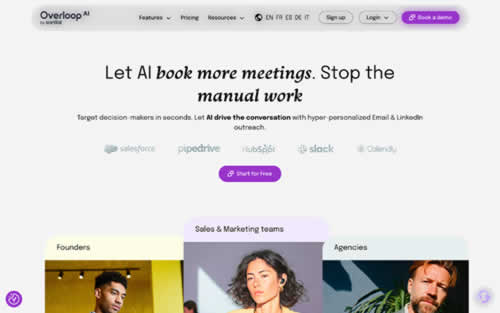
Overloop is the standout for a small team, because it collapses what would otherwise be three tools into one. It finds contacts from a database of over 450 million profiles, runs outreach across both LinkedIn and email in a single sequence, and follows up automatically, then syncs to your CRM.
For a founder, the practical win is speed. You can go from a target website to a running campaign in an afternoon, without buying a separate data tool or a separate sender and wiring them together. The AI builds the list and the sequence, and you approve before anything goes out.
At $69 per month for Starter and $99 per month for Growth with a free trial, it is priced for a small business, not an enterprise, which is what makes a real outbound motion affordable for a lean team.
Best for: small teams that want to find and reach customers without a stack of tools.
Watch out for: you will still want a CRM alongside it to manage deals long term.
2. Apollo: A Heavier Database Alternative

Apollo bundles a large B2B database with outreach, which makes it a heavier alternative for a small team that wants more database depth. If raw coverage matters to you and you do not mind a bigger tool, it gives you a lot to prospect from in one place.
The database breadth is the reason to consider it. You can filter a large universe of records and start sequences without a separate finder, which appeals to teams that want scale early.
The trade-off for a small business is complexity. Apollo is a larger platform to learn and administer than a focused tool, and data accuracy still needs verifying, so it can be more than a lean team needs.
Best for: small teams that specifically want a large database to prospect from.
Watch out for: more platform and setup than many small teams need.
3. Pipedrive: A Simple, Sales-Focused CRM
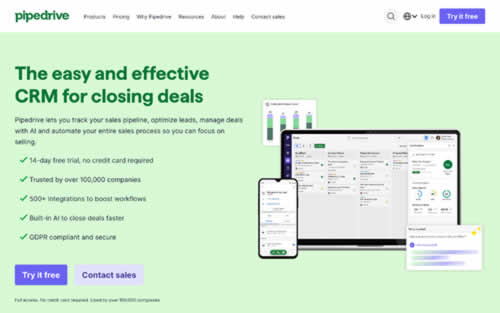
Pipedrive is a perennial small-business favorite, a clean and affordable CRM built around the sales pipeline that is genuinely easy to adopt. For a team replacing a spreadsheet, it gives structure without the weight of an enterprise CRM.
The pipeline-first design is the appeal. Deals move visually through stages, activities are easy to log, and a small team can be productive in it almost immediately, which is exactly what a business without an ops person needs.
It is focused on pipeline management rather than being an all-in-one marketing and service suite, so teams wanting to expand into broader automation later sometimes look elsewhere.
Best for: small teams that want a simple, affordable, sales-focused CRM.
Watch out for: narrower than full marketing-and-service suites.
4. Hubspot: A Free CRM That Scales With You
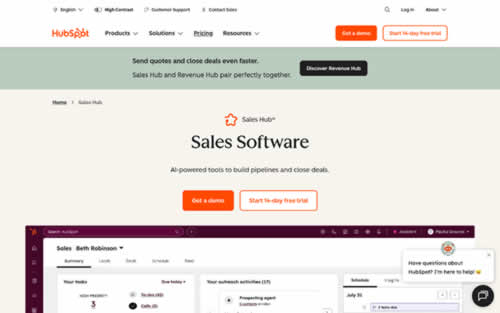
HubSpot offers a capable free CRM tier that grows with you, which makes it a safe default if you want room to expand into marketing and service later. A small team can start at no cost and add paid features as it grows.
The advantage is headroom. You get contact management, deal tracking, and email tools for free, and the same platform extends into marketing automation and support if you need it, so you are not migrating CRMs later.
The flip side is that the broader you go, the more it costs and the more there is to manage, so a team that only ever needs a sales pipeline may find Pipedrive simpler.
Best for: small teams that want a free CRM with room to grow.
Watch out for: costs and complexity rise as you adopt the wider suite.
5. Calendly: Remove The Scheduling Back-And-Forth
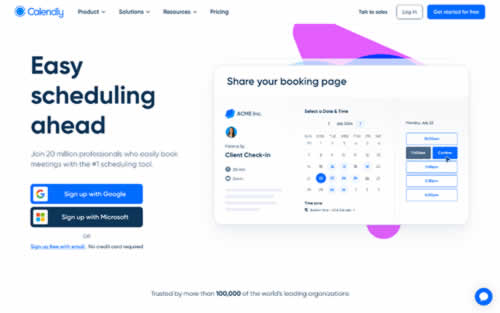
Calendly removes the back-and-forth of booking meetings by letting prospects pick a time from your real availability. For a small team, that means fewer dropped opportunities between interest and a booked call.
The value is simple and immediate. Share a link, and the scheduling, time-zone math, and reminders happen without email tag, which keeps deals moving when a founder is juggling everything at once.
It does one job, so it is a complement to your outreach and CRM rather than a replacement for either. Paired with a tool that automates follow-ups, it closes the gap cheaply.
Best for: any small team that wants to remove booking friction.
Watch out for: it is a scheduler, so it sits alongside your outreach and CRM.
6. Mailshake: Simple, Reliable Email Outreach
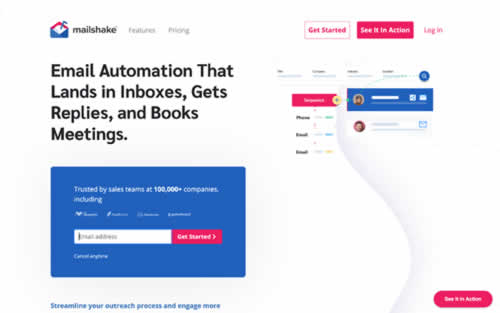
Mailshake is a clean, dependable cold email sender that small teams can run without a learning curve. You build a sequence, personalize with variables, and let follow-ups fire automatically, which is exactly the level of outreach most small businesses need.
The appeal is getting effective campaigns live quickly. There is no complex platform to wrestle, just disciplined sending and reply tracking, which suits a founder or a couple of reps.
It is lighter on built-in data and multichannel depth than the all-in-one tools, so you supply your list and add LinkedIn elsewhere if you need it.
Best for: small teams that want simple, reliable email outreach.
Watch out for: bring your own data, and limited multichannel depth.
7. Snov.Io: Affordable Find, Verify, And Send
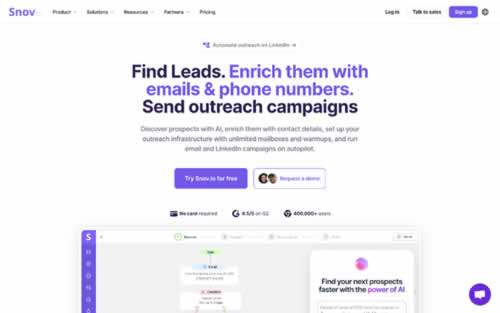
Snov.io bundles email finding, verification, and light outreach at a price built for small teams. For a business that wants a bit of everything in one inexpensive subscription, it covers finding an address, checking it, and running a simple sequence.
The value is breadth at low cost. A lean team gets the core jobs without paying for or learning a larger platform, which makes it a common first paid tool.
Because it spans many jobs, no single part is the deepest, so growing teams sometimes move up as volume increases.
Best for: small teams wanting find, verify, and light outreach cheaply.
Watch out for: depth is limited as you scale.
8. Lusha: Quick Verified Contacts As You Prospect
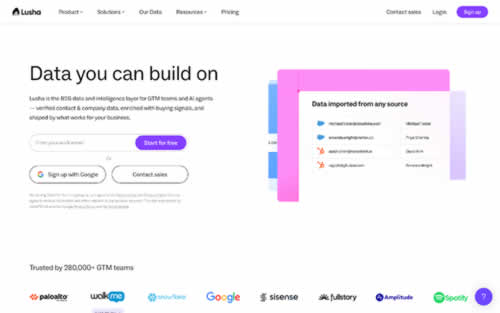
Lusha is a fast way for a small team to pull verified contacts, including phone numbers, via a browser extension while researching prospects. It surfaces details on the spot, which fits a team that works prospect by prospect rather than building big lists.
The strength is speed on individual contacts and a focus on compliant data, useful for small teams that also call.
It is credit-based and a finder, so watch the cost at volume and plan to send from your outreach tool.
Best for: small teams wanting quick verified contacts, including phones.
Watch out for: credit costs, and no built-in outreach.
Comparison
| tool |
Job |
Why a small team likes it |
| Overloop |
Find + reach customers |
Data, LinkedIn, email, CRM sync in one |
| Apollo |
Find + reach |
Large database |
| Pipedrive |
Pipeline CRM |
Simple, sales-focused |
| HubSpot |
CRM + growth |
Free tier, scales up |
| Calendly |
Scheduling |
Removes booking friction |
| Mailshake |
Email outreach |
Simple, reliable sending |
| Snov.io |
Find + light outreach |
A bit of everything, cheap |
| Lusha |
Contact data |
Quick verified contacts and phones |
The smallest stack that works
For most small businesses, the lean setup is one outreach tool that includes data, plus one simple CRM. Overloop for finding and reaching customers, and Pipedrive or HubSpot to manage the pipeline, covers the whole motion without sprawl or enterprise cost.
FAQ
What sales tools does a small business actually need? At minimum, a way to find and reach customers and a way to track deals. A tool like Overloop covers the first, and a simple CRM like Pipedrive or HubSpot covers the second. Everything else is optional.
Are these tools affordable for a small team? Yes. The tools here start in the tens of dollars per month, and several have free tiers. And of course, tools that
perform multiple functions keep the overall cost low.
Can one tool handle outreach across email and LinkedIn? Yes. Overloop runs both channels in one sequence, which is ideal for a small team that cannot manage separate tools for each.
The Bottom line
Big sales suites are built for big teams and priced for them. A small business wins with a lean stack: one tool to find and reach customers, one to track them. Overloop is the most efficient choice for the first job, covering data and multichannel outreach in a single affordable subscription, so a small team can sell like a much larger one

If you'd like to learn more about what we provide, why not take a look at how we can help?
Boost your skills with our market-leading online courses at super-low prices.