Turning an ambitious idea into a working digital product takes more than inspiration - it requires the right technical foundation. Google Cloud Consulting Services bridge the gap between your original concept and execution, helping people to turn their visions into scalable, secure, and effective solutions. Whether you're developing a data-driven app, modernizing infrastructure, or incorporating AI into your business model, Google Cloud experts can provide the guidance and support to guarantee progress.

The ecosystem is designed for performance, flexibility, and continuous improvement, so teams can move smoothly from prototype to production. This ZandaX article looks at how Google Cloud Consulting transforms creative concepts into real, production-ready systems that can actually generate a measurable return. In this way, your ideas won’t just launch successfully but evolve with your business over the long term.
And it’s here that
Google Cloud consulting services become a crucial element. Consultants help companies with the initial concept, and also with the architecture, development, roll-out and optimization stages. Here, we show you the full journey from idea to code … and the reasons why expert guidance is a must in this process.
What Are Google Cloud Consulting Services?
Consulting services for Google Cloud help companies with planning, designing, adopting, and optimizing solutions on Google's Cloud Platform. These services draw upon strategic business, specific architecture and engineering knowledge to make sure that the organization's cloud initiatives are in sync with its goals.
Consulting for Google Cloud is not just limited to primary support or infrastructure management, but rather it is focused on four main areas:
- Translating business requirements into cloud designs
- Choosing the most appropriate services and tools
- Making sure of security, compliance, and scalability
- Permitting effective development and operations
Not only is the goal to migrate the workloads to the cloud, but also to create solutions that will be able to support the growth and innovation of the company in the long run.
From Concept to Code: The Project Lifecycle
Successful transformation is carried out in a structured manner and through a lifecycle that blends together the business vision with the technical execution. And you need to be supportive of this complete journey, not just isolated execution tasks.

The lifecycle usually comprises:
- Stating the business concept and vision
- Creating an infrastructure that is both scalable and secure
- Building and putting cloud-native applications into operation
- Transferring and modernizing existing systems
- Improving performance, cost, and operations
This complete strategy guarantees that solutions aren’t just ready for production but also maintainable and in line with the company's overall objectives.
Cloud Development and Implementation
This is the stage when ideas are transformed into operational solutions, and consultants either supervise or execute the development using best practices.
By adhering to modern development practices, companies can release the features more quickly, gain reliability, and do so at the same time, according to demand. At times, experienced teams like N-iX are the ones to support organizations by integrating mastery of consulting with practical engineering in order to speed up delivery.
Migration and Modernization on Google Cloud
When it comes to adoption, for most companies, it means a change in their legacy system too. So you need to ensure secure and quick migration and modernization.
Successfully migrating and modernizing existing systems starts with a few key steps. It begins by checking whether your existing applications and data are ready to move, and identifying any dependencies or potential risks early on. Once that’s clear, it’s time to decide on the right migration strategy based on what best fits your goals.
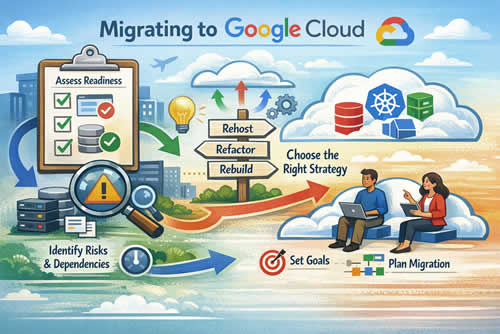
Older applications often need updating to become fully cloud-native, creating better performance and easier scalability. Many companies also take a hybrid or multi-cloud approach so they balance flexibility, security, and cost. And most important of all, every stage of the process should aim to minimize downtime and avoid unnecessary disruption, so the business stays up and running while the transformation takes place.
To put it simply, modernization allows companies to introduce new features and, at the same time, keep existing business processes running smoothly.
Ongoing Support, Managed Services, and Innovation
Moving to the cloud isn’t a one-time project - it’s an ongoing journey of optimization and innovation. Once your systems are in place, continuous improvement becomes part of the process. This can include regular monitoring, proactive incident management, and ongoing performance/cost optimization to keep everything running smoothly and efficiently.
It also means planning ahead for scalability and capacity as your needs evolve, and taking advantage of new features and services as cloud providers release them. By continuously refining and evolving your cloud setup, you make sure it always delivers value, performance, and the flexibility your business needs.
But why choose consulting services instead of doing it yourself? Well, although some organizations may try to do this on their own, this sometimes leads to wasted effort and unexpected risks, with obvious negative consequences.
And using expert consultants with proven track records helps companies realize the value of their investment much faster. For example, they reduce the risk of security or compliance gaps; they improve the quality and cost‑effectiveness of architectural decisions; and they ensure that industry best practices are being applied throughout the project. As a result, they avoid many of the usual pitfalls of cloud projects and are better placed to achieve a strong return on their investment … while staying secure and compliant.

The Most Suitable Industries
Google Cloud consulting is, in fact, the most effective one that can be applied in different industries, but some of the sectors benefit the most, most likely due to their scale, the amount of data they use, or the effect of regulatory demands on them.
Some of the industries that most often use this include:
- Tech and SaaS companies
- Finance and fintech businesses
- Health and life science sectors
- Retail and eCommerce
- Media, gaming, and digital entertainment sectors
In all these industries, cloud consulting provides companies with the ability to generate new ideas and products faster, while ensuring that their operations are both reliable and compliant with regulations.
How to Pick the Best Partner
Success – as with any collaboration – greatly depends on the choice of the right partner.
Some main criteria are:
- The status of their Google Cloud certification and that of being a partner
- Having a history of working with similar workloads or in similar industries
- Possessing expertise in security and compliance
- Providing end-to-end delivery that covers every stage from strategy to support
- Having open communication and making available documented case studies
Quality partners (we’ve mentioned n-IX, for example) merge strategic plans with extensive engineering skills, enabling organizations to smoothly transition from idea to production.

If you'd like to learn more about what we provide, why not take a look at how we can help?
Boost your skills with our market-leading online courses at super-low prices.
Conclusion: Turning Your Vision into Business Reality
The use of Google Cloud consulting services makes it possible for companies to build fearless concepts into solutions that aren’t only scalable, secure, and high-performing but also ready for production. By taking care at all stages - from strategy and architecture to development, migration, and optimization - companies are able to lower their risks and speed up innovation.
In the digital world that is rapidly getting more competitive, being successful is going to demand more than just the right tools and infrastructure. It is going to demand a well-structured approach, a partner with proven expertise, and the right partner who can guide the whole process from the very first idea to the coding stage.