Higher education SEO has been part of enrollment marketing for more than a decade. Until recently, the job was fairly clear. Improve Google rankings, bring more students to the right pages, and turn that traffic into enquiries. That still matters. But it is no longer the whole story.
More students now begin their research by
asking AI tools for advice. They may ask ChatGPT which universities offer strong graduate programs in a subject. They may use Gemini or Perplexity to compare options before visiting a university website. They may see Google AI Overviews before they ever click a normal search result.
This means universities are no longer competing only for Google rankings. They are also competing to be mentioned, trusted, and recommended by AI search tools.

For enrollment and marketing teams, the real question is now simple. Which higher education SEO agencies understand AI search visibility as well as traditional SEO? And which agencies are still working as if Google rankings are the only channel that matters?
In this ZandaX article, we answer these questions.
What AI Search Visibility Means for Higher Education SEO
AI search visibility works differently from traditional Google rankings, although there is some overlap. Google mainly looks at page quality, technical SEO, backlinks, content structure, and relevance to a search query. These are still important.
AI platforms look at a wider set of signals. They try to understand which institutions are credible, relevant, and commonly recognized across the web. That means they may rely on university websites, rankings, directories, listicles, third-party articles, forums, reviews, and other sources that help form a broader picture.
This creates a practical problem. A university can rank well in Google but still be missing from AI-generated recommendations. That happens because the signals used by Google and AI tools are not exactly the same. For example, a university might have strong program pages and good organic rankings. But if it rarely appears in respected education lists, third-party comparisons, directories, or subject-specific rankings, AI tools may not treat it as an obvious recommendation.
This is why higher education SEO now needs to include
web consensus building. That means creating a stronger and more consistent presence across the external sources that AI tools are likely to reference. And the best agencies combine traditional SEO with digital PR, structured content, third-party citations, and AI search strategy. They help universities become easier to find, easier to understand, and easier for AI platforms to recommend.
Best Higher Education SEO Agencies for AI Search Visibility
1. Manaferra
Best for Higher Education SEO, GEO, and AI Search Visibility
Manaferra is an information discovery agency that specializes in higher education SEO and Generative Engine Optimization. It helps universities get found across the channels students now use, including Google, ChatGPT, Gemini, and Perplexity.
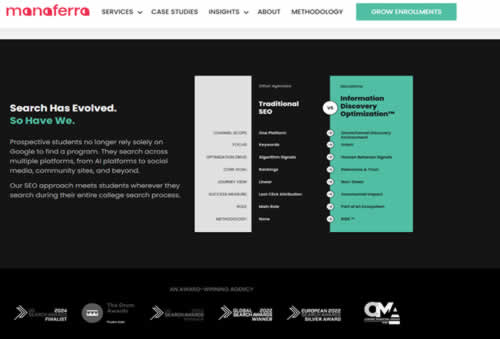
Its work is built around the
IDO™ Framework,, which stands for Information Discovery Optimization. The idea is to improve how institutions are discovered across the full student research journey, not just through normal search results. For AI search visibility, this approach covers several important areas.
Technical SEO and program page structure help AI platforms extract clear and accurate information. Strong content architecture makes it easier for AI tools to understand programs, entry requirements, outcomes, and areas of expertise.
Manaferra also focuses on web consensus building. This means improving a university’s presence across the external sources that AI tools may use when judging credibility. These can include education listicles, rankings, directories, and third-party articles. Digital PR and citation strategy then help build the wider authority signals that support both traditional SEO and AI search visibility.
Manaferra has worked with education institutions and brands including Harvard SEAS, CEIBS, UND, iSchool Syracuse, and Swiss Education Group. It is a strong fit for universities, graduate schools, business schools, and higher education brands that want a specialist SEO partner for the modern search landscape.
Key differentiator: Manaferra connects technical SEO, GEO, AI search visibility, content strategy, digital PR, and web consensus building into one structured approach.
2. Carnegie
Best for Large-Scale Enrollment Marketing
Carnegie is best suited to institutions that need large-scale enrollment marketing support. Its strength is not only SEO, but the wider infrastructure around student recruitment. The agency combines audience intelligence, digital advertising, and multi-channel enrollment communications. This makes it useful for universities that need to run campaigns across many programs, student groups, and recruitment stages.
Carnegie also brings long experience in higher education. That matters because enrollment marketing is not the same as ordinary lead generation. Universities need to understand student intent, application cycles, parental influence, program demand, and regional differences. For institutions managing high-volume campaigns, Carnegie offers a strong operational partner. It is especially useful where SEO sits alongside paid media, data-driven targeting, and broad recruitment activity.
Key differentiator: Carnegie provides large-scale enrollment marketing infrastructure, backed by audience intelligence and strong campaign execution.
3. VisionPoint Marketing
Best for Organic Content Discovery
VisionPoint Marketing is a strong option for universities that want to build long-term organic search visibility. Its work focuses on content and SEO foundations. This includes program pages, educational content, and student-focused search journeys. Rather than writing mainly from an institutional point of view, the agency focuses on what prospective students are actually trying to find.
That matters because students rarely search in the same way universities describe themselves. A student may not search for a department name. They may search by career outcome, study format, subject interest, salary potential, or whether a program fits around work.
VisionPoint’s approach is useful for institutions that want organic visibility to build over time. Good content can keep attracting students across several admissions cycles, without needing the same level of ongoing paid media spend.
Key differentiator: VisionPoint builds higher education content around real student intent, helping program pages gain lasting organic search authority.
4. EducationDynamics
Best for Enrollment-Focused Student Acquisition
EducationDynamics is strongest where institutions need direct access to prospective students who are already researching education options. The agency uses student-facing media properties and audience data to connect universities with high-intent prospects. This makes it useful when an institution needs qualified enquiries now, not only long-term SEO growth.
This type of support can sit alongside SEO and AI visibility work. SEO may build long-term discovery. AI search visibility may improve how often a university is mentioned in AI-generated answers. But some institutions also need immediate enquiry volume for admissions teams.
EducationDynamics is a good fit where that direct acquisition need is the priority.
Key differentiator: EducationDynamics connects institutions with students who are already actively researching programs and education options.

5. SimpsonScarborough
Best for Institutional Brand and Positioning Strategy
SimpsonScarborough focuses on brand strategy and positioning. This matters because visibility alone does not guarantee enrollment results. A university may get more traffic, more mentions, and more awareness, but still fail to convert that attention into enquiries or applications. When that happens, the problem is often messaging.
If prospective students cannot quickly understand what makes an institution different, they may move on. This is especially true in crowded markets, where many universities make similar claims about quality, support, outcomes, and flexibility. SimpsonScarborough uses market research to understand how students see an institution compared with its competitors. That insight can then shape clearer positioning and stronger messaging.
This kind of work supports SEO and AI search visibility because it gives the institution a clearer story. When that story is consistent across the website, external sources, and recruitment communications, visibility is more likely to turn into action.
Key differentiator: SimpsonScarborough helps universities define genuine differentiation, so increased visibility is more likely to become enrollment interest.
6. Spark451
Best for Integrated Enrollment Communications
Spark451 is best suited to institutions that need better communication across the enrollment journey.
SEO and AI visibility may help students discover a university. But once they do, the next question is whether the message stays consistent. A student may move from an AI recommendation to a program page, then to an email, then to an open day invitation, then to an admissions conversation. If those touchpoints feel disconnected, the student journey weakens.
Spark451 helps universities create integrated enrollment communications. This can improve the way students move from initial awareness to application and enrollment. And it is especially useful for institutions where discovery is improving, but conversion is still underperforming. In that situation, the issue may not be visibility. It may be the story students meet after they first discover the institution.
Key differentiator: Spark451 helps turn search and AI-driven awareness into stronger enrollment engagement through consistent communications.

If you'd like to learn more about what we provide, why not take a look at how we can help?
Boost your skills with our market-leading online courses at super-low prices.
How to Evaluate Higher Education SEO Agencies for AI Search Visibility
Choosing a higher education SEO agency now requires more than checking whether it can improve rankings. There are three useful questions to ask.
First, does the agency have a clear method for building web consensus? In other words, can it improve the institution’s presence across the third-party sources AI platforms may reference, such as directories, listicles, rankings, and education media?
Second, does the agency treat traditional SEO and AI search visibility as one connected strategy? They should not be completely separate services. The same content, authority, structure, and reputation signals can often support both.
Third, does the agency measure the right outcomes? Rankings and traffic are useful, but universities ultimately need qualified enquiries, applications, and enrolled students. A strong agency should understand that visibility only matters when it supports the enrollment pipeline.
Agencies best equipped for AI search visibility will be able to explain their method clearly. They will not simply rename ordinary SEO as AI optimization. They will show how they build the wider signals that help AI platforms understand and recommend an institution. Higher education SEO has moved beyond the old model of ranking pages and reporting traffic. That model still matters, but it is no longer enough.
Students now discover institutions through Google, AI Overviews, ChatGPT, Gemini, Perplexity, directories, social proof, rankings, and third-party content. The strongest agencies understand this wider discovery journey and help universities become visible across it.