Training courses are a great way to improve the effectiveness of a company’s workforce. However, it can be difficult for managers to negotiate the various categories and learning formats available. Some managers prefer employees to attend online training programs, as they consider e-learning an inexpensive alternative to formal training. Others think it’s worth sending employees to attend lessons in a classroom environment, away from the noise and pressures of the work area where they can create a network with other learners, sharing experiences and thoughts.
But what about the employees themselves?
What Do Workers Value More as a Source Of Professional Training?
Many managers might assume that employees prefer e-learning, because they can access their online training courses anywhere, anytime, without travelling to a specific place to attend the course. But, according to our research, this is not the true sentiment.

We conducted a survey, asking 1,000 workers across the UK which source of professional training they value more. The respondents were given three predetermined responses to choose their answers from:
- Classroom training
- Self-study
- E-Learning courses
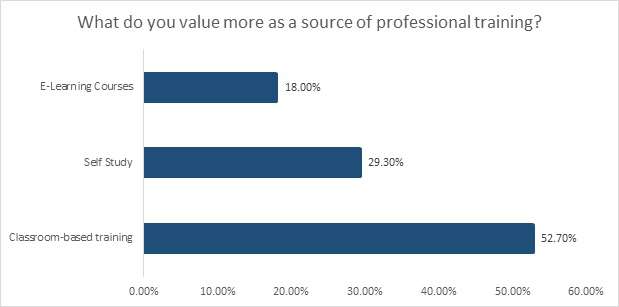
The research shows some surprising results. More than half of respondents (52.7%) feel that classroom training is the most valuable source of professional development, while a minority - 18% to be exact – prefers online training. One quarter of surveyed workers (23.3%) do not consider training courses valuable, and simply prefer self-study.
Young Employees Don’t See the Value of E-Learning
This might seem unexpected in the modern age, but young employees were amongst the least interested in online learning. Social media, smartphones, and virtual reality may be major influences on the lives of millennials, yet surprisingly, young people seem to find e-learning a turn-off – they’d rather have real-world interaction.
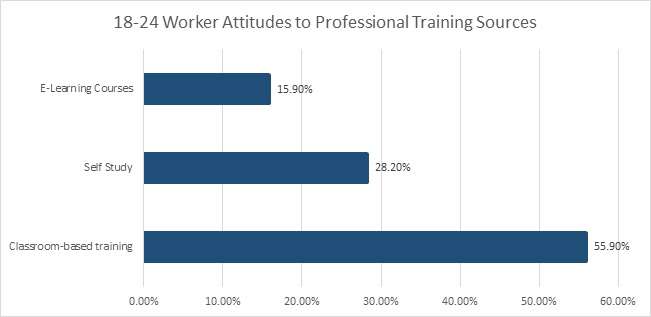
Overwhelmingly, the graph shows that over 55% of employees aged 18-24 consider classroom-based training to be the best source of professional training, followed by self-study. The generation of digital natives actually seems to still value the traditional classroom environment when it comes to corporate training. Only 15.90% of respondents of this age group said they value e-learning more than the two other sources of training.
Experienced Workers Believe More in Online Training
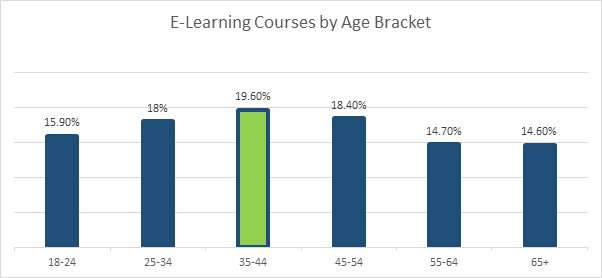
Workers in the age group 35-44 are the most interested in online training. For these busy professionals, time management is often the biggest challenge in their professional development plan, and e-learning suits those who want to learn in their own time. Moreover, mid-career, they perhaps feel that their qualifications need a boost to keep up with the pace of technological change.
Men Value More Self-Study; Women Prefer Face-To-Face Learning
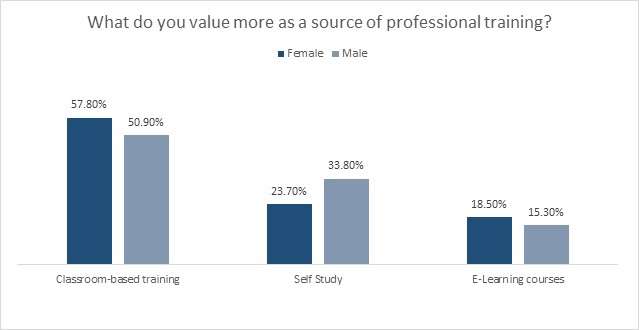
Women, on average, appear to be slightly more engaged by professional training than men. Females represent 57.8% of the total respondents who prefer classroom training, whilst the 18.5% of people who valued e-learning more are women.
A classroom environment allows for instant expression of thoughts, with face-to-face interaction with classmates and the instructor. But more men tend to prefer independent study; in fact, a third of male workers believe that self-study is the most valuable source of professional development.
Example: A Breakdown of the United Kingdom
We also compared the four countries in the UK to see how different cultural attitudes towards work and professional development would have reflected on the results of the surveys.

As you can see, England and Northern Ireland are poles apart in their attitudes. In spite of a general preference for classroom training across the UK, England seems to be the most online-oriented region (perhaps propelled by London’s role in leading the country towards digitalization). Almost a fifth of workers who chose e-learning are English, while only 4.2% are from Northern Ireland.
Predictably then, Northern Ireland is the region most loyal to traditional training. 63% of Irish respondents consider face to face courses the best training source.
And it seems that Scottish and Welsh workers don’t believe as much in training courses. In these two countries, they picked self-study more than other regions.
Conclusions from the Report
Business managers in industries and countries all over the world are investing in training their workforce, and the outcome of our survey confirms that employees appreciate this. The majority of workers (72%) feel that either classroom-based courses or online training would be a valuable benefit for their professional development.

If you'd like to learn more about what we provide, why not take a look at how we can help?
Boost your skills with our market-leading online courses at super-low prices.
As you'd probably expect, workers want to improve their skills and most of them want to do that in a classroom environment that allows for face-to-face interaction with classmates and the instructor. But it's fair to say that because of its advantages in both cost and convenience, e-learning will undoubtedly grow in popularity.
It’s also positive to see that young workers are the most interested in growing their professional skills, with more than half of the respondents thinking that classroom-based training is the most valuable source of training.