Most job seekers don't realize they're losing hours every week to the kind of tasks a computer could handle in minutes. Tools for an automated job search have improved beyond recognition, but picking the wrong one still costs you time, it leads to application form mismatches, or (worse) gets you flagged by platforms watching for bot activity. Staying relevant across dozens of job boards while keeping applications personalized is a whole lot harder than it sounds.
 After thorough reviews of top platforms, this ZandaX guide breaks down seven tools that actually deliver on their promises.
How this ranking was put together
Publicly available information from user reviews, feature pages, directories, and verified ratings shaped every pick in this list. Only platforms with a real track record in job search automation made the cut.
Why Fully Automated Job Search Tools Merit a Closer Look
The real challenge is to achieve volume without sacrificing quality. Sending 50 generic applications a day rarely beats
5-10 well-targeted ones, so the best tools balance speed with enough personalization to keep response rates healthy. Get this right and the difference shows up fast: more relevant listings discovered each day, fewer hours spent filling out the same form fields over and over, and an application-to-interview conversion rate that actually justifies the effort.
Picking the right tool here isn't a minor decision. A poor fit means wasted application attempts, accounts flagged by platform bot-detection systems, and cover letters that read like they were written by a machine running on autopilot (not necessarily CoPilot…)
1. RoboApply
Best for Job Seekers Automating Applications at Scale
RoboApply is a platform built out of Dallas, Texas that covers the full pipeline, from finding relevant listings across 40+ job boards to submitting tailored resumes and cover letters for each.
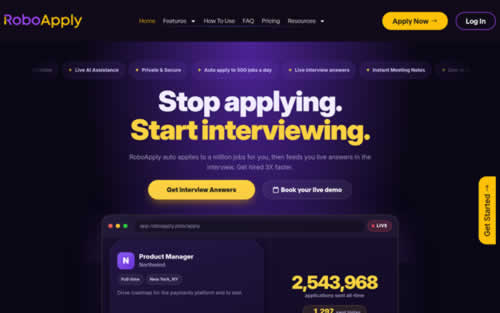
They cap out at 500 auto-applications per day, which is actually hard to match anywhere else in this space! Their AI adjusts resume language to fit each job description before applying, so applications don't read like copy-paste jobs. The Interview Copilot is their standout feature: it delivers real-time answers during live interviews without being visible on screen share, which is a genuinely useful edge during video calls.
What Sets RoboApply Apart?
RoboApply solves one of the biggest gaps in automation: the drop-off between submitting applications and actually getting into interviews. Their combination of resume personalization, hiring manager outreach, and live interview support addresses the full funnel, not just the top of it.
What Users Are Saying:
RoboApply has earned a 4.8-star rating across 6,200+ reviews and counts 170,000+ users who have collectively landed 100,000+ jobs. Users consistently flag the volume of applications it handles without sacrificing relevance. The 90-day interview guarantee is something users mention as a real confidence signal, not just marketing copy.
2. Teal
Best for Resume Tailoring and Application Management
Teal is a career platform built around two main jobs: making your resume work harder and keeping your applications organized.
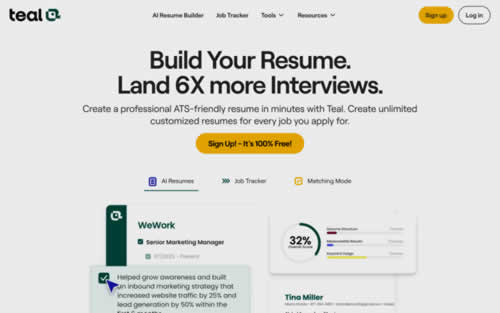
Their AI Resume Builder pulls keywords directly from job descriptions and adjusts your resume content to match, which saves a surprising amount of manual effort per application. The Job Application Tracker sits alongside it, giving users a single place to monitor every open application across multiple boards. They offer a free plan and a Pro tier at $29/month, making it accessible for people who aren't ready to commit to a paid subscription right away.
What Sets Teal Apart?
The problem Teal tackles is the resume mismatch issue: most applicants send the same resume everywhere, which inevitably destroys response rates. Their keyword extraction approach directly addresses this by making tailoring fast enough so users actually do it consistently.
What Users Are Saying:
Honestly, the feedback on Teal leans heavily toward the organizational side. Users talk about finally feeling in control of a messy search, with the tracker replacing scattered spreadsheets and bookmark folders. The AI resume features get credit for cutting down time spent rewriting the same bullet points for every new role.
3. Job Copilot
Best for Automated Job Search and Applications
Job Copilot is a newer platform, founded in 2024, that comes loaded with nine integrated tools covering almost every stage of the application process.
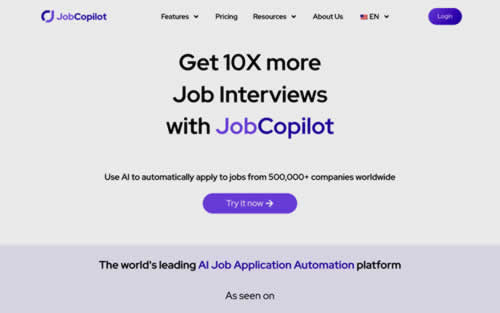
They search across 500,000+ company career pages globally and, notably, only apply to positions verified on official company websites rather than scraped aggregator listings. That's a meaningful quality filter. Their suite includes an AI resume builder, cover letter generator, mock interviewer, application tracker, and career advisory features. Pricing starts around $0.93 per day, which makes it one of the more affordable full-suite options in this category.
What Sets Job Copilot Apart?
Job Copilot filters out low-quality listings before wasting application attempts on them, which is a problem that costs people real time, as well as credibility. Their founding team brings direct experience from job sites and recruitment, so the product design reflects actual knowledge of how hiring pipelines work.
What Users Are Saying:
Job Copilot is a newer entry, so the public review pool is still building out. Early users respond well to the verified-listing approach and the depth of tools packed into one subscription. The 7-day money-back guarantee gives new users a low-risk way to test whether the tool actually fits their workflow.
4. LoopCV
Best for Job Search Automation and Recruitment
LoopCV has been running since 2019 out of Greece and has grown to 50,000+ users across more than 90 countries.
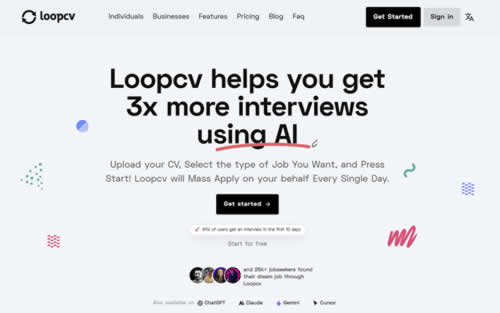
Their platform auto-applies across 30+ job boards, uses machine learning to match listings to user profiles, and automates recruiter outreach alongside the standard application process. CV improvement tools are built in, and the whole thing comes with a free-forever plan that doesn't require a credit card. That last part is unusually rare in this space, since most competitors hide their free tiers behind sign-up friction.
What Sets LoopCV Apart?
LoopCV addresses the barrier to entry that keeps many job seekers from trying automation at all: cost and commitment. Their genuinely free plan, combined with ML-powered job matching, lets users validate the tool's relevance to their search before spending anything.
What Users Are Saying:
LoopCV holds a 4.1-star rating on Trustpilot from 122+ reviews. Users call out the auto-apply functionality as reliable and the interface as easy to pick up without a learning curve. The free plan earns consistent appreciation, particularly from users who are cautious about paying for tools they haven't tested yet.
5. aiApply
Best for Job Seekers Across Different Skill Levels and Experience Ranges
aiApply launched in 2023 out of the UK and has since helped 300,000+ job seekers work through the application and interview preparation process.
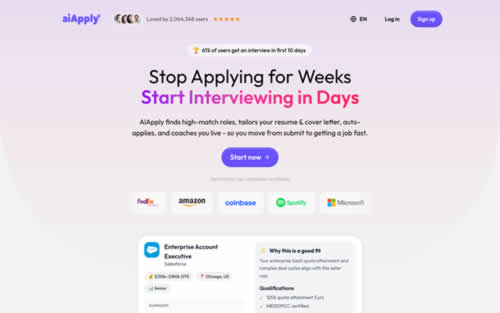
The platform covers resume building, cover letter generation, auto-apply functionality, and interview prep through a mock interview tool and an interview buddy feature. They run a freemium model, so the entry point is accessible regardless of where someone is in their search. Backing from Tech Nation Group and Haatch gives the company some institutional credibility for a team of only three people.
What Sets aiApply Apart?
aiApply is built to serve job seekers at very different career stages, from recent graduates figuring out their first applications to experienced professionals switching industries. That range of use cases makes the platform more flexible than tools built exclusively for high-volume power users.
What Users Are Saying:
aiApply sits at a 4.3-star rating on Trustpilot based on 700+ reviews. Users across experience levels report that the AI-generated content feels more personalized than they expected, particularly the cover letters. Interview preparation gets strong marks too, with users noting it reduced anxiety heading into real conversations with hiring managers.
6. LazyApply
Best for Automated Job Search and Bulk Applications
LazyApply has been running since 2020 and focuses squarely on volume: helping users submit applications across Greenhouse, Dice, Indeed, ZipRecruiter, and more with minimal manual input.
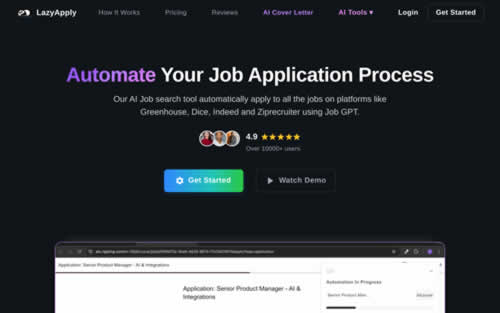
Their Job GPT technology fills out application fields based on user profile data, and smart referral emails are routinely sent to employees at target companies, which adds a networking layer most auto-apply tools skip entirely. A real-time analytics dashboard shows application status, so users aren't left guessing whether their submissions went through.
What Sets LazyApply Apart?
LazyApply combines bulk application volume with account protection logic designed to reduce the risk of getting flagged or blocked by employment platforms. That kind of built-in safety thinking is rare and matters a lot when running high-volume campaigns across multiple boards.
What Users Are Saying:
The user base is vocal about results: a 4.9-star rating and 10,000+ users who report applying to 100+ positions within days. Multiple users describe receiving interview callbacks and offers directly tied to the platform's activity. That consistency across reviews is hard to dismiss as coincidence.
7. Sonara
Best for Automated Search and Application Submissions
Sonara works like a job application agent: users set up a profile once, and the platform continuously scans vacancies, matches listings to their preferences, and submits tailored applications on their behalf.
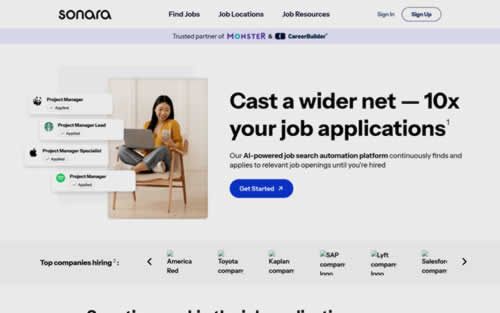
The model is closer to a service than a tool, in that users approve applications before they go out rather than managing settings manually. Sonara was acquired by BOLD, a parent company behind several career platforms, which adds operational stability to what started as a smaller startup. For people who want a hands-off experience, this “setup-and-forget” model works well.
What Sets Sonara Apart?
Sonara removes the most tedious part of job searching entirely by functioning as an agent rather than just software. The BOLD acquisition signals that the platform has enough market value to attract a serious parent company, which is a reasonable indicator of long-term success.
What Users Are Saying:
Public review data for Sonara is limited given its acquisition and positioning as a more passive tool. From what's available, users respond well to the low-friction approach: set your preferences, review suggested applications, and let the system handle the rest. That simplicity resonates particularly with the large numbers of people who find other tools overly complex to configure.
Methodology Behind These Picks
The research process started by pulling together a broad list of platforms available to users in the United States. Sources included software directories, career-focused review platforms, and official product websites. Company descriptions, feature sets, founding histories, and team sizes were all collected to build an initial pool of candidates worth examining further.
The Shortlist Cut
From that initial pool, platforms were narrowed down by removing options that lacked verifiable user activity or had no meaningful presence in credible review channels. Review patterns were analyzed for consistency: platforms where positive feedback was thin, non-specific, or concentrated in a suspicious window were deprioritized. Only options with a real, readable history of user activity remained after this stage.
Fact-Checking the Picks
Claims made on each platform's official website were cross-referenced against what actual users reported in reviews and public forums. Where a company claimed specific application volumes, response rates, or unique features, those claims were checked against available evidence from third-party sources. Platforms where marketing language significantly diverged from user-reported experience were either removed or noted carefully.
Authority Signals and Industry Standing
Each platform was also evaluated for signals of credibility beyond user reviews. Funding history, acquisition records, mentions in career and technology publications, and founding team backgrounds all factored in. A company with deep roots in the recruiting industry (like Job Copilot's founding team) or institutional backing (like aiApply's investors) carries different weight than one with no verifiable track record.
Tools For A Fully Automated Job Search Track Record
Finally, each platform was assessed for its performance in the job automation category. That meant looking for dedicated feature pages around auto-apply, resume tailoring, and application tracking, plus verified case studies or user stories showing real application-to-interview outcomes. Platforms that treated automation as a side feature rather than a main capability were weighted lower in the final selection.

If you'd like to learn more about what we provide, why not take a look at how we can help?
Boost your skills with our market-leading online courses at super-low prices.
Picking the Right Tools
Not every tool in this list will fit every job seeker. The right pick depends on what stage of the search you're in, how much volume you're targeting, and what your budget looks like. Here's what to think through before committing.
- Industry/Domain Experience: Some platforms are built by people with recruiting backgrounds. Others are pure software plays. If your target roles are niche or technical, a platform with domain knowledge tends to produce better matches.
- Features and Service Offerings: Auto-apply is the baseline. But look at what else is included: resume tailoring, cover letter generation, interview prep, and recruiter outreach all add real value beyond just submitting forms.
- Pricing Structure: Free plans and trials exist across this category. Start there before paying, especially since application quality can vary platform to platform depending on your resume content and target roles.
- Results Measurement: A good tool should show you what's happening. Application tracking dashboards, response rate visibility, and active pipeline counts help you adjust your approach instead of applying blindly.
- Industry Knowledge and Compliance: Job platforms actively work to detect and block automated activity. Pick a tool that's transparent about how it handles platform terms of service and account protection, because losing access mid-search is a real setback.
Our Verdict
Choosing the right tool really comes down to
what you actually need from it. High-volume applicants will lean toward platforms like RoboApply or LazyApply. Organization-first job seekers will find Teal more useful. Budget-conscious users have a real option with LoopCV's free plan. This category is growing fast, and the tools are getting meaningfully smarter about personalization, account safety, and tracking outcomes across the full application pipeline.
To make the best choice, decide on where you fit in all this, and hopefully our article will help you to make an informed choice on how to move forward.