Most businesses don't realize their employee training is broken until something expensive goes wrong. A compliance audit with no completion records. A new hire who was onboarded on vibes and tribal knowledge. A product launch where the sales team simply wasn't ready.
Do you know: 1 in 3 new hires start looking for another job soon after joining because of a poor onboarding experience. That's not a retention problem. That's a training infrastructure problem. And at that point, the scramble begins. Someone exports a spreadsheet. Someone else shares a folder of PowerPoints. A manager runs the same training session for the fourth time that quarter.
 In this ZandaX article, we show how learning management systems exist to end that cycle. And that picking the right one matters much more than most buying guides may tell you.
What Is a Learning Management System?
A
learning management system (LMS) is software that lets organizations create, deliver and manage training programs. It's the infrastructure that turns a pile of course materials into a measurable, repeatable learning experience for every employee, contractor, or partner on your roster.
The right LMS doesn't just host content. It tells you who completed what, who got stuck, and whether the training actually moved the needle on performance.
What to Look Out for Before You Choose
Before the product comparison, a quick framework. The tools below differ in meaningful ways, and what works for a 10-person startup won't necessarily scale to a 3,000-person enterprise. Evaluate these before you demo anything:
- AI content creation: Can you build courses inside the platform, or do you have to import everything?
- Tracking and compliance: Can you pull audit trails, completion reports, and certification records on demand?
- Learner experience: Will your team actually use it, or will they find a workaround?
- Integration: Does it connect with your HRIS, CRM, or SSO tools without a custom engineering project?
- Pricing model: Are you paying per seat, per active learner, or a flat fee? This matters enormously as you scale.
The 6 Best Learning Management Systems for Businesses
The six tools below represent the strongest options across that range, so the right fit depends on where your business is today and where it's headed.
1. ProProfs LMS
ProProfs LMS is an AI-powered, cloud-based learning management system built for growing teams and enterprises that need to move fast without sacrificing structure.
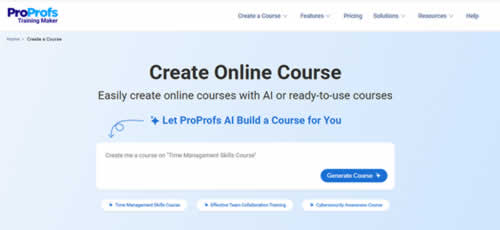
What’s impressive is that you can generate a complete course by typing a single prompt. For teams without a dedicated instructional designer, the deployment timeline changes considerably.
The library of 500+ expert-built, ready-to-use courses covers the topics HR teams most often return to, including harassment prevention, workplace safety, leadership development, and compliance.
Features such as gamification and branching scenarios keep learners engaged beyond the first module.
The platform supports 70+ languages and integrates with HRIS, CRM, and SSO tools. Pricing starts free for growing teams, with paid plans beginning at $1.99 per active learner per month.
Best for: Growing businesses or enterprises that need fast course creation, compliance training, and measurable results without heavy setup.
Pros:
- AI course builder saves significant time
- Large prebuilt course library reduces work from scratch
- Strong anti-cheating quiz settings for compliance accuracy
- Supports 70+ languages
- Integrates with HRIS, CRM, and SSO
Cons:
- No on-premise version
- No dark mode
2. TalentLMS
TalentLMS is one of the more widely used platforms in the mid-market, and for good reason. The interface is clean, setup is relatively painless, and it handles a broad range of training types without requiring technical expertise.
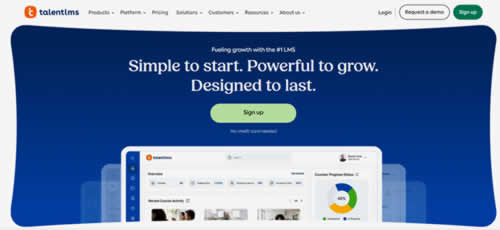
You can white-label the platform, create separate portals for different departments or client groups, and set up automated enrollment rules so new hires land in the right training sequence without manual intervention.
The reporting suite covers completions, scores, and time-on-course, though some users find it less granular than they'd like for compliance-heavy industries.
The pricing jumps noticeably as you add users, which is worth modeling before you commit.
Best for: Mid-size businesses with moderate technical capacity and a need for multi-audience training delivery.
Pros:
- Clean, intuitive interface
- Solid white-labeling and multi-portal setup
- Strong SCORM/xAPI compatibility
- Automated enrollment workflows
Cons:
- Reporting depth limited for complex compliance needs
- Pricing scales steeply with user count
3. Docebo
Docebo sits at the enterprise end of the market. It's a powerful platform built for large organizations that need to train employees, partners, and customers simultaneously across different learning environments.

The AI-powered content curation feature surfaces relevant material to learners based on their role and behavior, which addresses one of the real problems with large content libraries: people don't find what they need.
The tradeoff is complexity. Docebo takes significant time to configure, and smaller teams will find they're paying for functionality they won't use. Implementation usually requires dedicated resources, not just an afternoon.
Best for: Large enterprises managing multi-audience, multi-region training at scale.
Pros:
- AI-driven content discovery
- Strong social and peer learning features
- Robust partner and customer training support
Cons:
- Steep learning curve
- Overkill for teams under a few hundred employees
4. Absorb LMS
Absorb is built for organizations that take online training software seriously as an operational function, not just a compliance checkbox.
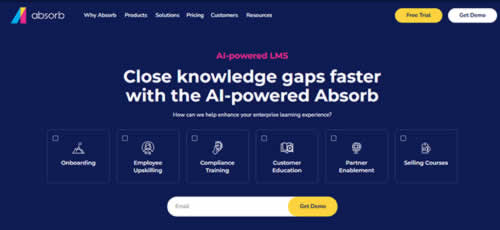
The platform is well-regarded for its learner experience, which is cleaner and more consumer-grade than many corporate tools manage to achieve. The reporting module is strong and customizable, and the mobile experience is one of the better ones in this category.
Where Absorb lags is in content creation. It's primarily a delivery and management platform, so if you want to build rich courses in-platform, you'll likely need a separate authoring tool in your stack.
Best for: Mid-size to enterprise teams that prioritize learner experience and have existing content to deploy.
Pros:
- Polished learner experience
- Strong certification and compliance tracking
- Good mobile experience
- Detailed, customizable reporting
Cons:
- Limited native course-building tools
- Higher price point
5. 360Learning
360Learning takes a different philosophical approach from most corporate training tools.
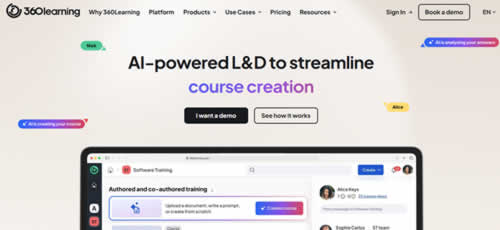
Rather than treating training as a top-down delivery mechanism, it's built around collaborative learning, where subject-matter experts inside your organization create and maintain courses alongside formal L&D content. This works surprisingly well for companies where much institutional knowledge resides with individual contributors rather than in documented materials.
The caveat: this model requires buy-in from people across the organization, not just the L&D team. If your culture doesn't support that kind of participation, the collaborative features won't deliver their full value, leaving you with a functional but unremarkable delivery platform.
Best for: Companies with distributed expertise and a culture that supports peer-to-peer knowledge sharing.
Pros:
- Strong collaborative course creation
- Fast course publishing from internal experts
- Tight learner feedback integration
Cons:
- Collaborative model requires cultural adoption
- Less suited for pure compliance training delivery
6. Cornerstone OnDemand
Cornerstone is a long-established name in enterprise corporate training tools, and its platform reflects that.
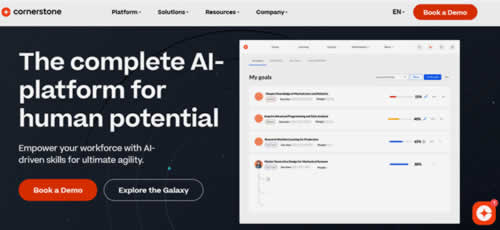
It covers the full spectrum: learning, performance management, recruiting, and workforce planning, which makes it appealing to large organizations that want one system rather than a stack of integrated tools.
For companies already running on Cornerstone, the LMS component is a natural extension rather than a separate decision.
The honest limitation is that this breadth comes at a cost, both financial and operational. Implementation is a project, not a setup. Smaller organizations routinely find that they're configured for roughly 30% of what they're paying for.
Best for: Large enterprises already invested in the Cornerstone ecosystem, or organizations that want a unified HCM and learning platform.
Pros:
- Comprehensive suite covering learning and performance
- Mature compliance and certification tracking
- Strong skills and succession planning features
Cons:
- Complex and expensive to implement
- Significant overkill for smaller teams
How to Make the Final Call
A platform comparison can only take you so far. Before you sign anything, run a pilot with actual employees, not just the IT team and HR leadership. The platform your learners will actually use is worth more than the one with the longest feature list.
A few questions worth asking before the free trial ends:
- Can a non-technical admin build and update courses without help?
- Can you pull a compliance report for a specific department in under five minutes?
- Does the mobile experience hold up on the devices your workforce actually uses?
The best LMS for your business is the one that removes the friction between having something to teach and knowing what was actually learned. Everything else is just noise…

Now Pick One … and Start!
Choosing a learning management system isn't really a software decision. It's a decision about
whether your organization is serious about building consistent, measurable training or it’s still ok with absorbing the hidden (and significant) costs of not having it.
The platforms on this list cover a wide range of needs, from AI-assisted course building for growing teams to enterprise-grade compliance infrastructure for large organizations. None of them is a perfect fit for everyone, which is exactly why the evaluation criteria matter more than any feature comparison.
Start with the problem you're actually trying to solve. Build from there. And before you commit to anything, make sure the people who will use it every day had a say in the decision.

If you'd like to learn more about what we provide, why not take a look at how we can help?
Boost your skills with our market-leading online courses at super-low prices.