So, despite your best efforts, your team isn’t exactly setting the world alight when it comes to performance ... well, whose fault is that? When your team is more FCL Red Sox than Boston Red Sox, it can be tempting to blame the players rather than the manager. But this is often a mistake.

While accountability matters, in many cases the problem isn’t down to laziness or apathy but a lack of clarity and direction - and micromanaging will usually only make the issue worse.
In this ZandaX article, we’re sharing our five-step action plan for motivating your underperforming team and getting them set for the success you want from them
Step 1: Diagnose the Root Cause: Skill vs Will
We can compare poor performance to an illness - while a lack of results may be the symptom, we can only cure it by figuring out what’s causing it. The best way to tackle this is to use the Skill vs Will Matrix.
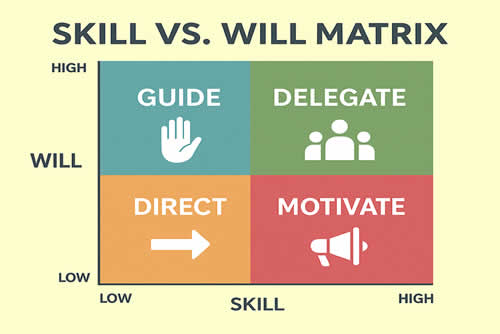
In short, the different states, with your actions, can be summarized as follows:
- High Will / Low Skill (The Beginner)
They are eager but inexperienced. Guide them: provide coaching, training, and a safe space to learn.
- Low Will / Low Skill (The Disillusioned)
They lack confidence or motivation. Direct them: identify the root cause, then set small, achievable tasks to build confidence.
- High Will / High Skill (The Star Player)
They are capable and motivated. Delegate to themL give them autonomy and clear objectives.
- Low Will / High Skill (The Capable but Bored)
They know how to do it but lack passion. Motivate them: use incentives and find what interests them and will boost their motivation.
At ZandaX we provide lots of management training, and we're firm advocates of adapting your leadership style to each situation (which isn’t difficult, trust us!) and we break this down as follows:
- Guide - Picture the scene; you have a brand new employee who is super eager but, at this stage, doesn’t have a whole lot of skills and experience under their belt; in other words, High Will / Low Skill. Your role here is to guide him or her through coaching and training and to create a safe space in which they can learn, make mistakes and self-assess without risk.
- Direct - Next up is your Low Will / Low Skill A lost cause, you may think – but not so, I respond. This may be a beginner who lacks confidence or an existing employee who has lost motivation or has become disillusioned. Your first job here is to figure out where the low will comes from and turn it around; and you do this by getting to know what interests and excites them. Next, you coach the employee while setting small achievable tasks - quick wins build confidence and motivation fast.
- Delegate - Hi, I’d like to introduce you to your star player - the High Will / High Skill guy or gal. Not only are they highly skilled but he or she is also super-motivated and looking for more responsibility. So give it to them! Your job here is to set objectives and delegate reasonable tasks that give them as much autonomy as possible. But don’t forget to support and encourage - just because this one’s a high achiever doesn’t mean that your praise won’t be appreciated. Quite the reverse, we’d say…
- Motivate - Last but not least, let’s meet our Low Will High Skill guy. This one knows what to do and how to do it - but just isn’t all that passionate about it. Here’s where you can really come into your own - find out what makes them tick and then use motivation and incentives - along with a good dollop of support and praise - to get them where you want them to be.
This subject is covered in more detail - from a management - and personal - view in our article
Skill vs Will: What is the True Driver of Success?
Step 2: Reset Expectations with SMART Goals
You should always get your staff to work to a plan, whether to achieve individual or team targets.
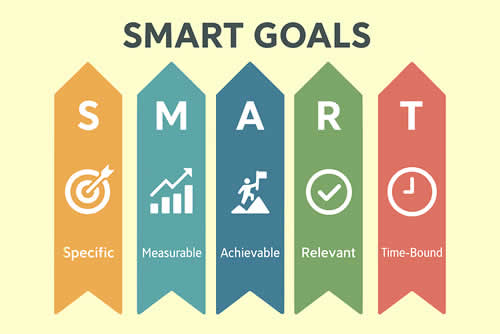
Here, SMART goals are your best option - and they work something like this:
S - Specific - Be clear on objectives, including who is involved, the location, and the reasons why. For example; “this coding project needs to be completed by Friday and Lisa will take lead, assisted by Ben, in the London office”.
M - Measurable - Set parameters, roadmaps, and reference points so you can track success along the way.
A - Achievable - It's absolutely vital that you set goals which are actually within people’s grasp. "Reaching for the stars" is fine, but nothing demotivates faster than working toward an impossible goal.
R - Relevant - aka "What’s the point?" Does your project or goal match up to your wider objectives and what value will it potentially add?
T – Time-Bound - Maintain focus by setting well-defined, realistic start and end dates.
This subject is covered in much more detail in our course on
Setting Goals the SMART Way ... it may be worth a look!
Step 3: Remove the “Hidden Blockers”
You know these - or maybe you don’t because you haven’t asked! If your team isn’t getting the job done it’s time to ask them why. For example; are they using outdated tools and equipment? Are they not getting enough support? Is too much bureaucracy tying up their time?
Often, a solution is relatively simple - but only if you know what the issues are in the first place. Get into the habit of speaking to your team regularly about any concerns or niggles they have. You’ll almost certainly be surprised by what you hear … and it just may make all the difference to performance (as long as you actually action it, of course!)

Step 4: Implement Feedback Loops
This high-falutin’ phrase is simply a way of saying that you could probably do with introducing a rule of frequent feedback to keep your team on track. In a lot of instances, businesses will hold quarterly or annual reviews with employees, which actually means that their opportunity to speak up doesn’t come along too often. Crisis situations often arise simply because feedback is too slow or too infrequent. Instead, work out a way that employees can give their feedback (anonymous if necessary) through
the SBI model:
S - Situation - What’s going on and why?
B - Behavior - Whose fault is it?
I - Impact - What does it mean for the team and the company as a whole?
When staff are encouraged to voice their opinions, they automatically feel valued and heard. But, more importantly, it also helps to nip issues in the bud before they grow tentacles and fangs and become problems.
Step 5: Define Consequences (Positive and Negative)
This bit is - quite literally - the bottom line when it comes to bolstering your team and achieving results. And - spoiler alert - it’s all about motivation. The thing about goals is that success and failure both have an impact. But when staff don’t know or understand the consequences, bad things can be allowed to happen.

We tend to work on two different types of motivation - first up,
extrinsic which is driven by external factors like bonuses or disciplinary procedures. With extrinsic motivation you might, for example, tell employees that if the project or task succeeds, they will receive a bonus. If, however, the task fails, this won’t happen and more work will be required.
Intrinsic motivation, on the other hand, is a much more personal thing which taps into interest, enjoyment and individual achievement . In this instance, the reward for success would be more responsibility and involvement whereas failure may mean missing out on a promotion.
As a tool for managers or team leaders, motivation needs to be used wisely. While incentives can be a really good thing, you do want to avoid coming across like you’re bribing your staff - which is never a good look.

If you'd like to learn more about how to manage staff who aren't as "connected" as they should be, we can help!
Boost your team management skills with our online courses.
RRP from $33 – limited time offer just
$14.99
Conclusion
Managing a team is essentially a juggling act - and it’s all too easy to drop the ball which can lead to underperformance. As we’ve shown in this article, the key is to dig deeper - you’re not a sports coach who can get away with the occasional pep talk and call it good. What’s needed is a proper strategy (or two) which makes employees accountable but with the right amount of guidance and support. Last but not least, feedback is the last word (and should also be the first) when it comes to identifying issues, bottlenecks and roadblocks that might be slowing your team down and causing underperformance.